
Meta's Privacy-First AI: Data Flow Control at Scale

Alps Wang
Jan 21, 2026 · 1 views
Data Privacy at AI Scale
Meta's Privacy-Aware Infrastructure (PAI) represents a significant step towards addressing the privacy challenges posed by the rapid growth of generative AI. The emphasis on embedding privacy controls directly into data storage, processing, and inference workflows is innovative. The use of a shared privacy library, PrivacyLib, for instrumentation and metadata emission is a crucial element for consistent policy enforcement. The focus on end-to-end data lineage is also noteworthy, providing the necessary visibility for continuous policy evaluation. However, the article lacks deep technical details on the specific mechanisms employed within PrivacyLib, the types of policy constraints supported, and the performance overhead associated with these privacy measures. Also, the article doesn't discuss the costs of implementing such a system. The complexity of managing data flows across thousands of interconnected services and pipelines could present significant operational challenges. Furthermore, the reliance on automated tooling for audit artifacts, while beneficial, might require robust monitoring and alerting systems to ensure the integrity and effectiveness of the privacy controls. This also raises the question of whether the tooling is open-sourced or proprietary.
From a competitive perspective, it's interesting to compare this to existing solutions. Several companies offer data lineage and governance tools, but the integration of privacy controls directly into the infrastructure at this scale seems to be a differentiator. The success of PAI will depend on the scalability of the lineage graph, the efficiency of policy enforcement, and the ability to adapt to evolving privacy regulations and AI advancements. This is a complex undertaking, and the long-term viability of the system will hinge on its ability to evolve alongside the rapid pace of innovation in the AI field. Open sourcing the PrivacyLib would greatly increase its impact and allow the community to contribute to its development.
Meta's approach to data privacy is a positive development, but like any large system, it has its challenges. The article highlights the importance of addressing privacy concerns in the context of AI development. It is crucial to understand the implications of this approach, especially for developers and companies building AI products. The details of the implementation will determine the success of the project.
Key Points
- Meta is expanding its Privacy-Aware Infrastructure (PAI) to manage data flows and enforce privacy compliance in GenAI workloads.
- A key component is large-scale data lineage, tracked through PrivacyLib, embedded across infrastructure layers.
- Policy-based controls are being used to govern data storage, access, and usage, with enforcement actions including logging and blocking.
- Privacy workflows are organized around understanding data, discovering data flows, enforcing policies, and demonstrating compliance.
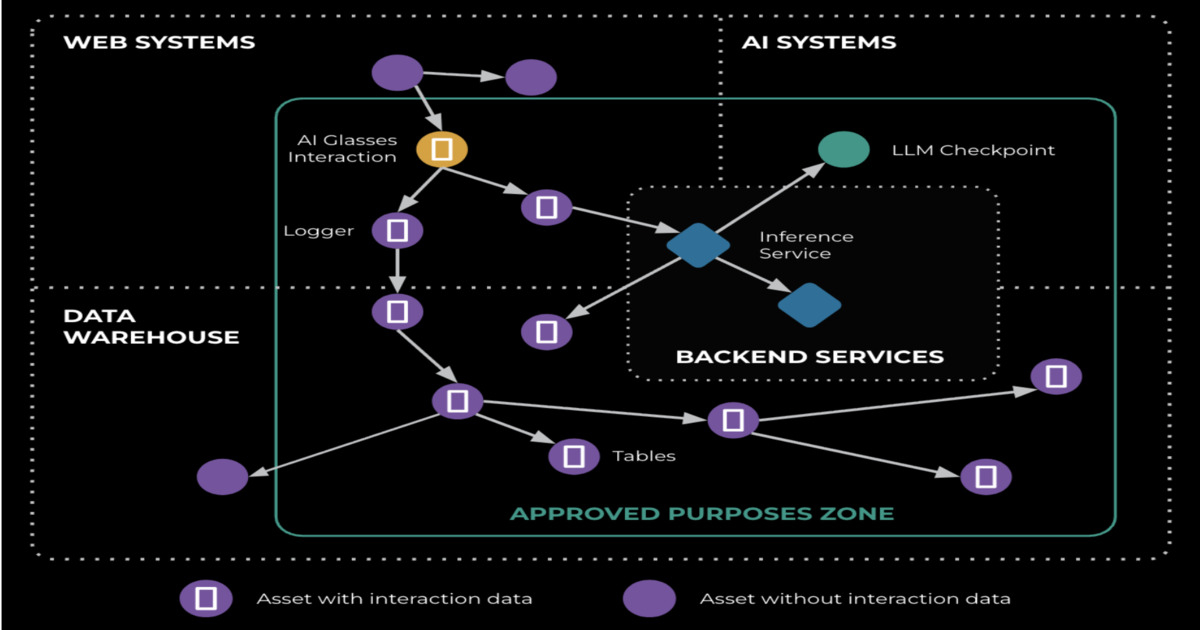
📖 Source: Tracking and Controlling Data Flows at Scale in GenAI: Meta’s Privacy-Aware Infrastructure
Related Articles
Comments (0)
No comments yet. Be the first to comment!