
Meta's AI-Powered Mutation Testing for Compliance

Alps Wang
Jan 7, 2026 · 1 views
AI-Driven Testing: A Paradigm Shift
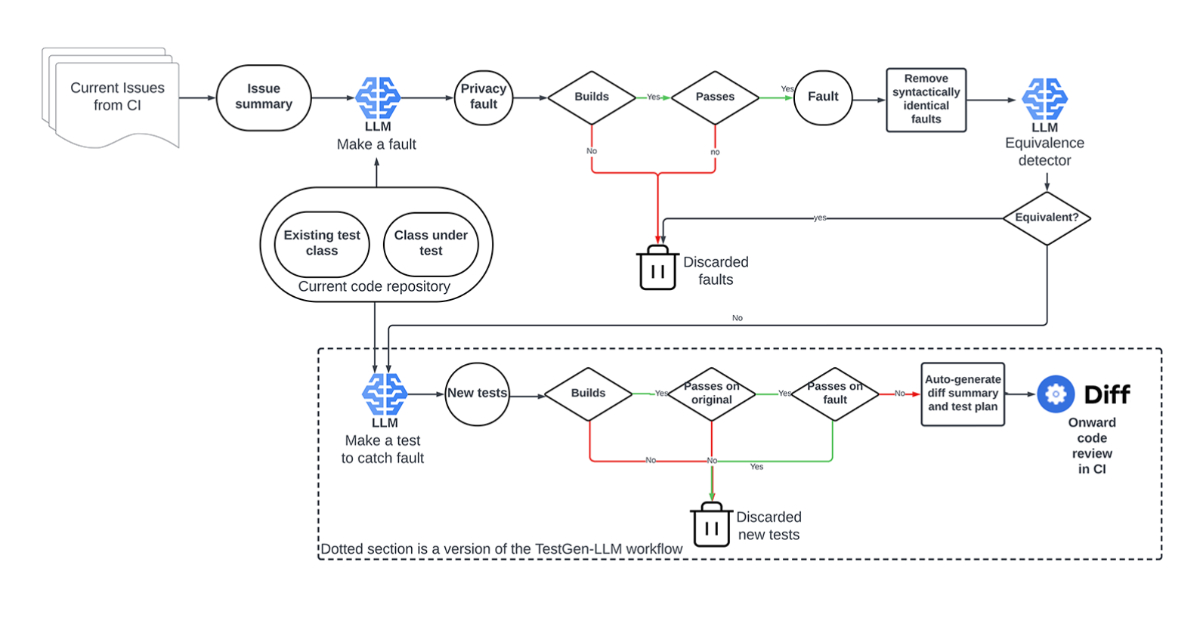
Meta's application of LLMs to mutation testing represents a significant advancement in software quality assurance, particularly in the context of compliance. The use of LLMs to generate context-aware mutants and tests addresses the scalability and accuracy limitations of traditional mutation testing, which often produces a high volume of irrelevant mutants. The early results, with a 73% acceptance rate of generated tests and 36% judged as privacy-relevant, are promising. The integration within the Automated Compliance Hardening (ACH) system and the subsequent JiTTest Challenge further highlight Meta's commitment to leveraging AI for automated software testing. However, the article lacks detailed technical specifications about the LLM models used, the specific prompt engineering techniques employed, and the computational resources required. Moreover, the long-term maintainability and potential biases inherent in LLM-generated tests warrant further investigation. The success of this approach is highly dependent on the quality and training data of the LLMs and continuous monitoring for drift or unexpected behavior is crucial.
Meta's approach, while innovative, faces challenges common to AI-driven systems. The reliance on LLMs introduces a degree of opacity, making it difficult to fully understand the rationale behind test generation and potentially hindering debugging. Furthermore, the effectiveness of the system is tied to the quality of the training data and the ability to accurately assess the semantic equivalence of mutants, which can be a complex problem. The article also touches upon the Test Oracle Problem, a persistent challenge in automated testing, and how Meta is addressing it with human oversight. While this is a practical solution, it introduces a manual element that could impact the scalability of the system. The success of this approach hinges on the ability to balance the automation benefits of LLMs with human expertise and review. The adoption and usability of these tests depend on how developers interact with the output. More research is needed to determine the best interfaces and feedback mechanisms.
From a database perspective, the performance of the system will likely depend on the underlying database used to store and manage the mutants, tests, and results. Scaling this system to accommodate the large volumes of data generated by the LLMs will be crucial. The article does not discuss the database infrastructure used, but it's likely that a robust and scalable database solution is required. Additionally, the integration with existing compliance frameworks and the ability to generate tests that are relevant to specific regulatory requirements will be important factors in the overall success of the system. The article also does not fully address the cost implications of using LLMs, which could be a barrier to adoption for some organizations. The balance between LLM compute costs and engineering time saved is crucial for ROI.
Key Points
- Meta leverages LLMs for context-aware mutant generation and test creation, improving compliance coverage.
- The Automated Compliance Hardening (ACH) system integrates LLM-generated tests, reducing operational overhead.
- Early deployment across Facebook, Instagram, WhatsApp, and wearables platforms yielded significant results.
- The Catching Just-in-Time Test (JiTTest) Challenge further explores LLMs in automated software testing.
- Ongoing work focuses on expanding ACH, improving mutant generation, and addressing the Test Oracle Problem.
📖 Source: Meta Applies Mutation Testing with LLM to Improve Compliance Coverage
Related Articles
Comments (0)
No comments yet. Be the first to comment!