
Meta's AI-Driven Testing: 4x Bug Wins

Alps Wang
Apr 18, 2026 · 1 views
Shifting Testing Left with AI
Meta's reported 4x higher bug detection rate using Just-in-Time (JiT) testing, particularly in AI-assisted development workflows, represents a compelling evolution in software quality assurance. The core innovation lies in dynamically generating tests at pull request time, directly correlating them to code diffs and inferred developer intent. This contrasts sharply with traditional, often brittle, and high-maintenance test suites that struggle to keep pace with the rapid code generation characteristic of agentic AI. The integration of LLMs, program analysis, and mutation testing to create 'catching' tests, rather than just 'hardening' tests, is a sophisticated approach that aims to proactively identify future bugs. This paradigm shift from static correctness validation to change-specific fault detection is crucial for maintaining software integrity in increasingly automated development environments.
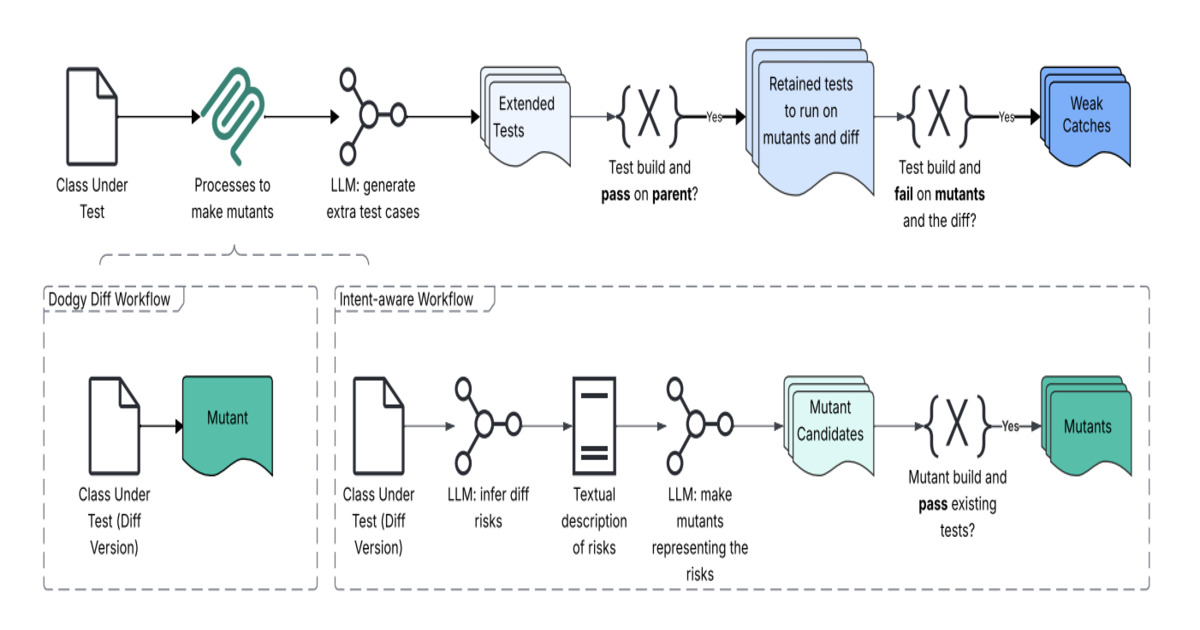
The implications for the tech industry are profound. As AI systems become more integral to code creation, the overhead of manually maintaining comprehensive test coverage will only escalate. JiT testing offers a scalable solution by offloading much of this burden to AI. The 'Dodgy Diff' and intent-aware workflow architecture, which treats code changes as semantic signals, is a particularly noteworthy technical detail, enabling more targeted and effective test generation. The reported success in identifying real defects with potential production impact underscores the practical value of this approach. Developers and QA engineers grappling with ever-expanding codebases and the speed of AI-driven development will find this methodology highly beneficial, potentially reducing release cycles and improving overall software robustness.
Key Points
- Meta reports a 4x improvement in bug detection using Just-in-Time (JiT) testing.
- JiT testing dynamically generates tests during code review, adapting to AI-generated code.
- The approach uses LLMs, program analysis, and mutation testing to create targeted 'catching' tests.
- Key innovations include the 'Dodgy Diff' and intent-aware workflow architecture.
- This shifts testing from static validation to change-specific fault detection, reducing maintenance overhead.
📖 Source: Meta Reports 4x Higher Bug Detection with Just-in-Time Testing
Related Articles
Comments (0)
No comments yet. Be the first to comment!