
MCP Toolbox: Seamless AI Agent-to-ClickHouse Vector Search

Alps Wang
Sep 7, 2026 · 2 views
Bridging the AI Agent-Database Vector Gap
The article effectively showcases MCP Toolbox's ability to abstract away the complexities of vector embedding and semantic search for AI agents interacting with ClickHouse. The core innovation lies in its declarative YAML configuration, which allows developers to define embedding models and tools, letting Toolbox handle the intricate text-to-vector-to-SQL pipeline transparently. This significantly reduces boilerplate code and maintenance overhead, a common pain point when integrating LLMs with vector databases. The seamless integration with ClickHouse's native vector capabilities, such as cosineDistance and HNSW indexes, is a strong technical highlight, enabling efficient and performant semantic search directly within the database.
However, a key limitation to consider is the current restriction to Gemini as the sole supported embedding provider. While Gemini is a powerful model, this limits flexibility for users who prefer or are already invested in other embedding services like OpenAI, Ollama, or cloud-specific offerings like Bedrock. The article acknowledges this by stating that users needing other providers must embed outside of Toolbox, which slightly diminishes the 'out-of-the-box' promise for a broader audience. Furthermore, the observation that embedded queries, including vectors, are fully logged in system.query_log could lead to significant storage inflation in high-throughput scenarios, a trade-off that users must carefully manage. The article also touches on security, noting that while injection is mitigated by the driver's serialization, it's not a true prepared statement, which might warrant further investigation for highly sensitive applications.
Despite these points, MCP Toolbox presents a compelling solution for developers building AI-powered applications that require semantic search capabilities. It's particularly beneficial for those already using or considering ClickHouse for their data analytics and vector storage needs. Teams looking to accelerate their AI agent development, reduce operational burden, and leverage the native vector capabilities of ClickHouse will find this a valuable tool. The ability to define and manage these complex workflows through simple YAML configurations democratizes access to advanced AI search functionalities, making it easier for developers to focus on application logic rather than infrastructure plumbing.
Key Points
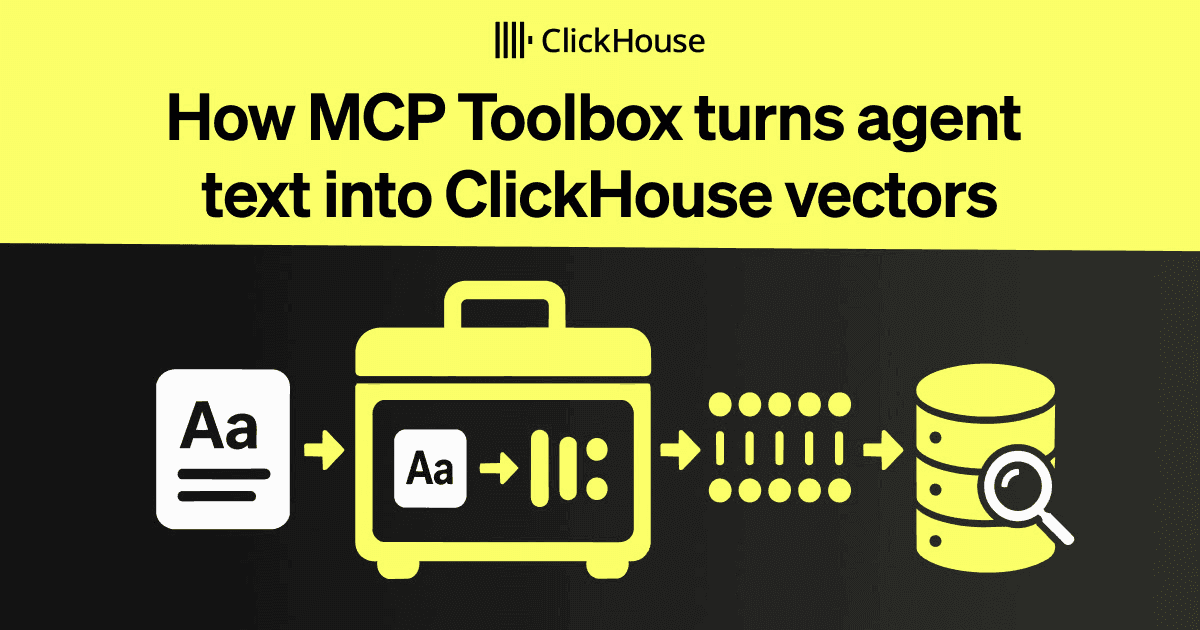
- MCP Toolbox bridges the gap between AI agents (text-based) and databases like ClickHouse (SQL/vector-based) by handling text-to-vector translation.
- It simplifies semantic search by allowing users to define embedding models and tools in YAML, abstracting away vector creation and SQL injection.
- Toolbox integrates directly with ClickHouse's vector capabilities, enabling native
cosineDistancecalculations and HNSW indexing for efficient semantic search. - The tool supports Gemini embedding models via API key or Google Cloud Project/Location authentication.
- Limitations include support for only Gemini embedding models currently and potential
system.query_loginflation due to logging full embedded queries.
📖 Source: How MCP Toolbox turns agent text into ClickHouse vectors
Related Articles
Comments (0)
No comments yet. Be the first to comment!