
Linux AI Policy Divergence: Navigating the Code Frontier

Alps Wang
Aug 10, 2026 · 1 views
The Human Firewall in AI's Code Evolution
The article effectively highlights the fragmented approach to AI policy within the Linux ecosystem, showcasing how different projects are grappling with the legal, technical, and philosophical challenges posed by AI-generated code. Key insights include the contrasting stances of GCC (restrictive due to legal/precision concerns) and the Linux kernel (pragmatic, emphasizing human accountability), as well as the more collaborative models emerging in Kubernetes and distribution efforts like Debian and Ubuntu. The piece excels at illustrating that there is no one-size-fits-all solution, and that context—whether it's the criticality of the software (compiler vs. application) or the community's governance model—heavily influences policy decisions. The emphasis on the 'human maintainer as the indispensable guardian' is a powerful recurring theme that resonates across all discussed projects, underscoring the continued importance of human oversight and understanding in software development, even with advanced AI tools. This focus on accountability and understanding is a critical differentiator, especially when compared to a purely automated workflow.
However, a potential limitation is the article's relatively brief exploration of the technical mechanisms for enforcing these policies. While it mentions disclosure requirements in Kubernetes and the kernel's 'explainability' rule, the practicalities of detecting AI-generated code or verifying a human's understanding of it are not deeply delved into. This is a complex technical challenge that will likely require more sophisticated tooling and methodologies in the future. Furthermore, while the article touches upon the 'philosophical purity' and 'software freedom' aspects for Debian, the specific criteria for determining if AI output aligns with the DFSG (Debian Free Software Guidelines) could be further elaborated. For instance, what constitutes proprietary training data or model weights from a legal and licensing perspective within the open-source framework? The article is highly beneficial for open-source project maintainers, legal counsel advising on AI in software development, and developers seeking to understand the evolving landscape of AI integration. The technical implications point towards a future where AI tools will be heavily scrutinized for their origin and impact on code integrity and licensing, potentially leading to new standards for AI-assisted development workflows. The comparison with Oracle's centralized GenAI policies for OpenJDK provides a useful counterpoint, illustrating the diversity of approaches from highly centralized to decentralized.
The article's strength lies in its ability to distill complex policy discussions into understandable narratives, providing a valuable snapshot of the current state of AI policy within a critical segment of the tech industry. The innovation lies in its comparative analysis, demonstrating that the Linux ecosystem, often perceived as monolithic, is in fact a petri dish of diverse policy experiments. This fragmentation, rather than being a weakness, is a sign of a healthy, adaptive ecosystem actively engaging with a transformative technology. The emphasis on human accountability as a universal constant is a particularly insightful takeaway, suggesting that the future of AI in software development will likely be one of human-AI collaboration rather than full automation, at least for critical infrastructure. The article could be enhanced by exploring the potential for AI tools to assist in verifying human understanding or detecting subtle AI-generated code anomalies, thereby bridging the gap between AI capabilities and policy enforcement. This would provide a more complete picture of how the ecosystem might evolve to meet these challenges.
Key Points
- The Linux ecosystem exhibits a fragmented approach to AI policy, with major projects like GCC, Linux kernel, Kubernetes, Debian, and Ubuntu adopting distinct strategies.
- GCC prioritizes legal integrity and compiler precision, leaning towards a prohibition of AI-generated patches.
- The Linux kernel emphasizes human accountability, requiring maintainers to fully understand and defend all code contributions, regardless of AI assistance.
- Kubernetes uses a disclosure-based model, treating AI as an advisory utility with strict transparency requirements.
- Debian is debating the philosophical implications of AI within its Free Software Guidelines, questioning the 'freeness' of AI output.
- A common theme across all approaches is the indispensable role of the human maintainer as the ultimate guardian of the code.
- Decentralized caution in the Linux ecosystem contrasts with centralized AI adoption management seen in other environments (e.g., Oracle's Java ecosystem).
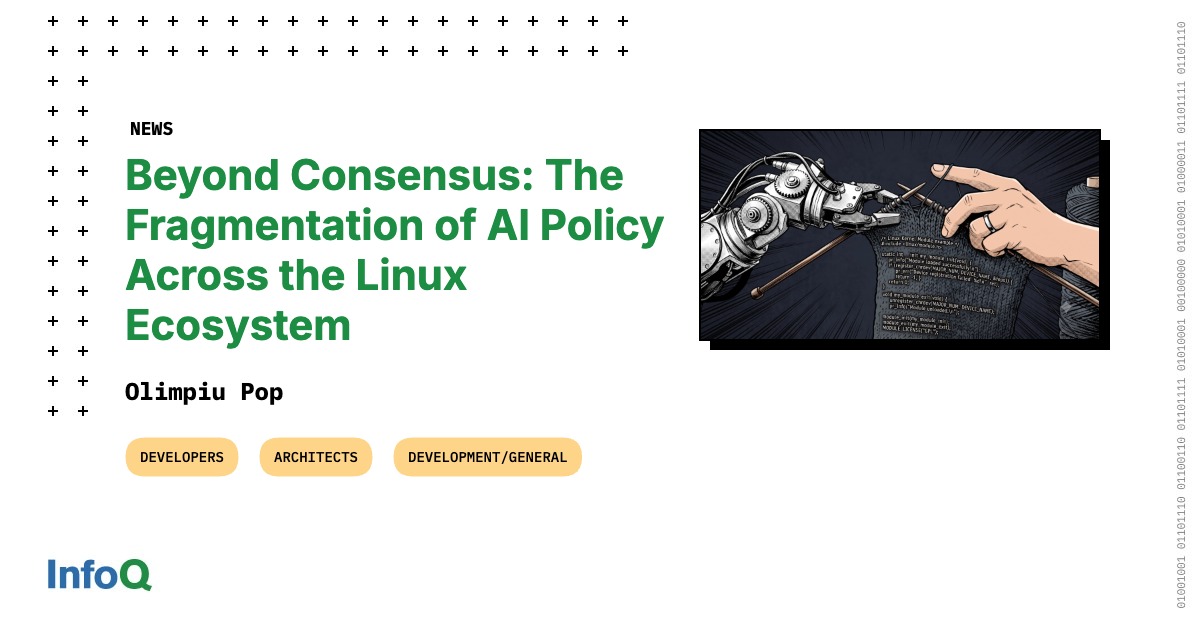
📖 Source: Beyond Consensus: The Fragmentation of AI Policy Across the Linux Ecosystem
Related Articles
Comments (0)
No comments yet. Be the first to comment!