
LinkedIn's AI Hiring Assistant: Architecting Agents

Alps Wang
Jan 1, 2026 · 1 views
Deconstructing LinkedIn's Agent Architecture
The LinkedIn Hiring Assistant article provides a valuable look into the evolution of AI at LinkedIn, specifically focusing on the architectural shift from simple prompt chains to a distributed agent platform. The move to a supervisor-sub-agent model, enabling parallel development and modular quality evaluation, is a key takeaway. The emphasis on addressing the time-consuming tasks of recruiters (candidate review) through AI is a practical application of AI in the real world. However, the article could benefit from more in-depth technical details, such as the specific LLM models employed, the data sources used for RAG, and the exact mechanisms for human-in-the-loop escalation and experiential memory. While the presentation touches on these aspects, a deeper dive would be more beneficial to a technical audience.
The modular architecture, which breaks down complex tasks into specialized sub-agents, is a good approach to scaling GAI chains. However, the article rightly acknowledges the potential for error propagation across multiple steps. The article does not address in detail the specific strategies used to mitigate this risk, such as error detection, retry mechanisms, or confidence scoring, which are crucial for maintaining the overall reliability and performance of the agent. Further, the reliance on external LLM services introduces dependencies and potential vendor lock-in, which should be considered, especially in a business context. Also, while the article highlights the importance of user experience, it does not provide many details on user testing or A/B testing, which are essential for iterative improvement.
Key Points
- LinkedIn transitioned from simple prompt chains to a supervisor-sub-agent model for its Hiring Assistant.
- The architecture employs a modular design with specialized sub-agents to handle different aspects of the recruiting process.
- The agent leverages advanced Retrieval-Augmented Generation (RAG) and experiential memory to improve performance.
- The article highlights the importance of addressing time-consuming tasks for recruiters, such as candidate review.
- The evolution reflects the shift from conversational assistants to task automation using agents.
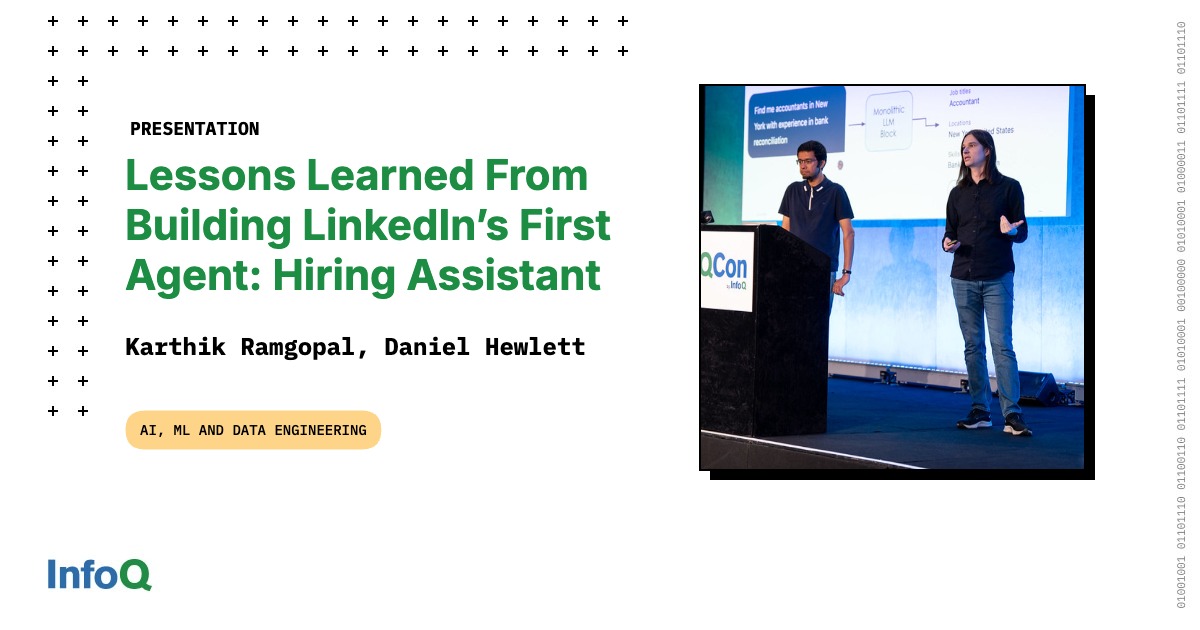
📖 Source: Presentation: Lessons Learned From Building LinkedIn’s First Agent: Hiring Assistant
Related Articles
Comments (0)
No comments yet. Be the first to comment!