
Knowledge Graphs: The Bedrock of Agentic AI

Alps Wang
Sep 12, 2026 · 2 views
Beyond Retrieval: Reasoning with KGs
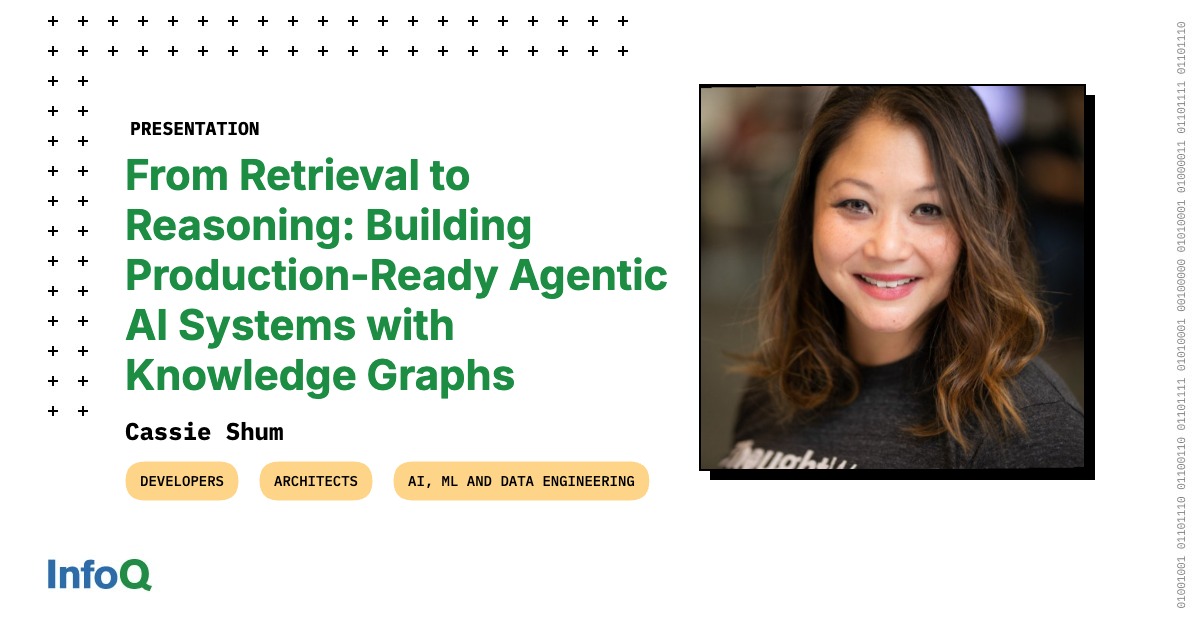
Cassie Shum's presentation provides a compelling argument for leveraging knowledge graphs (KGs) as a foundational element for agentic AI systems, moving beyond simple Retrieval-Augmented Generation (RAG). The core insight is that KGs offer a structured, semantic layer that enables richer reasoning, enhanced reliability, and better auditability compared to relying solely on large context windows or basic retrieval mechanisms. Shum emphasizes that the 'moat' for AI systems lies not in the models themselves, which are rapidly evolving, but in the proprietary domain knowledge captured and modeled within a KG. The practical architectural patterns—context bundling, decision provenance, code as truth, and agent visibility—are particularly valuable, offering concrete strategies for building production-ready systems. The demonstration of an engineering harness built on a KG to streamline feedback loops and optimize token usage is a strong indicator of the practical application of these concepts.
However, the presentation, while insightful, does acknowledge the rapid pace of change in the AI landscape, suggesting that even recent insights might need quick adaptation. A potential limitation, inherent in the topic, is the complexity and upfront investment required to build and maintain a robust knowledge graph. While Shum frames it as a substrate for reasoning, the initial effort to model domain knowledge accurately and comprehensively can be substantial. Furthermore, the effectiveness of the KG is directly tied to the quality and completeness of the data and relationships it represents. Ensuring this quality, especially when dealing with 'tribal knowledge' or legacy systems, presents a significant challenge. The presentation touches upon these challenges but could benefit from deeper dives into strategies for data ingestion, validation, and ongoing maintenance within an agentic workflow. The focus is clearly on the 'why' and 'what' of using KGs, with the 'how' of their implementation and integration being more implicitly demonstrated through the harness concept.
Key Points
- Knowledge Graphs (KGs) are crucial for building production-ready agentic AI systems, moving beyond basic RAG.
- KGs provide a structured, semantic layer for richer reasoning, reliability, and auditability, acting as a shared organizational context.
- The 'moat' in AI is the proprietary domain knowledge modeled in a KG, not just the evolving models.
- Four practical architectural patterns are proposed: context bundling, decision provenance, code as truth, and agent visibility.
- An engineering harness built on a KG can streamline feedback loops, optimize token usage, and enhance system reliability.
Related Articles
Comments (0)
No comments yet. Be the first to comment!