
Java's Carrier Classes: Revolutionizing Data Structures

Alps Wang
Feb 5, 2026 · 1 views
Unpacking Java's Data Revolution
The InfoQ article provides a clear overview of the proposed carrier classes and interfaces in Java, a significant evolution beyond the existing record feature. The core innovation lies in allowing more flexible data modeling than records, addressing limitations around derived values, mutability, and inheritance. This is particularly relevant in the context of Java's ongoing shift towards data-oriented programming, encouraging developers to treat data as a primary abstraction. The introduction of carrier interfaces is also noteworthy, as it offers a way to define state descriptions for interfaces, which can be useful for tuple-like abstractions. The article highlights the potential of combining carrier classes/interfaces with pattern matching and sealed types, promising more concise and type-safe code. However, the article is an early-stage exploration. The lack of concrete syntax, a JEP, or a release timeline means that developers can only speculate on the practical implications, and the precise benefits and costs will remain unclear until a concrete implementation is available. Furthermore, the article does not delve into the potential performance implications of carrier classes, especially concerning garbage collection and object instantiation overhead, which could be critical in performance-sensitive applications. Finally, the article needs more detailed comparisons with alternative approaches or languages that already offer similar features, to provide a more comprehensive understanding of the competitive landscape and potential trade-offs. More information is needed regarding how this will impact performance.
Key Points
- Java is exploring 'carrier classes' and 'carrier interfaces' to extend data-oriented programming beyond records, providing more flexibility in data modeling.
- Carrier classes offer a way to define a class's state while allowing for derived values, mutability, and inheritance—features not easily achievable with records.
- Carrier interfaces enable state descriptions for interfaces, supporting tuple-like abstractions and pattern matching across implementations.
- This approach aims to reduce boilerplate and encourage developers to treat data as a primary abstraction, simplifying APIs.
- The proposal is exploratory; no concrete syntax, JEP, or release timeline has been announced.
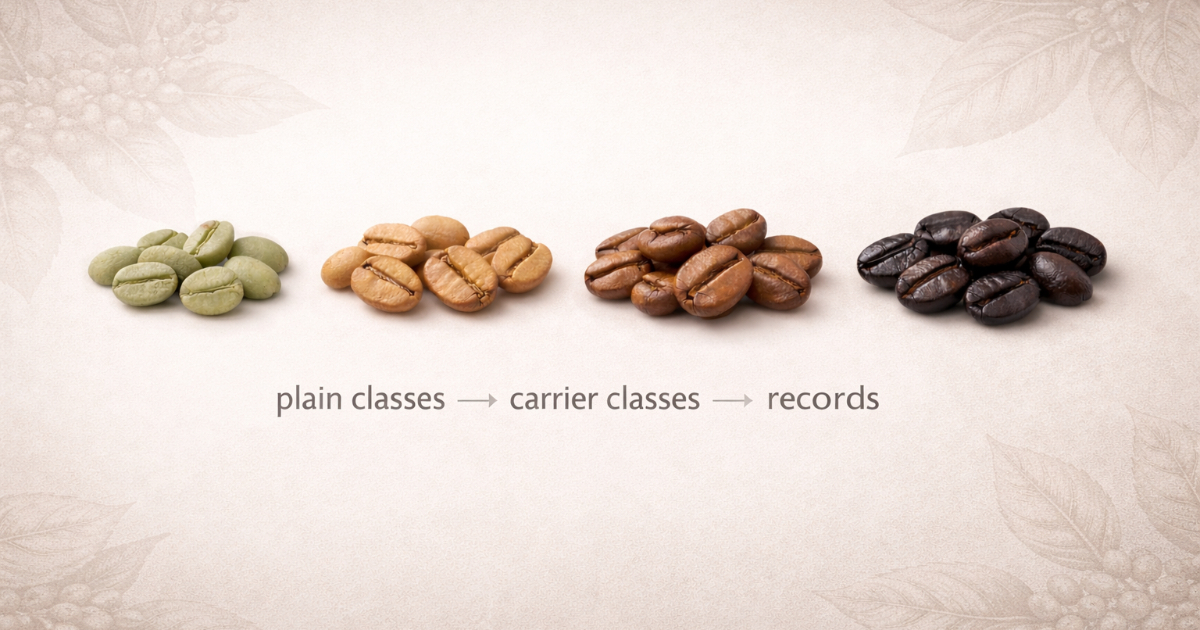
📖 Source: Java Explores Carrier Classes to Extend Data-Oriented Programming Beyond Records
Related Articles
Comments (0)
No comments yet. Be the first to comment!