
Java's AI Leap: Performance Boosts & Hardwood AI

Alps Wang
May 25, 2026 · 1 views
Java's Evolution in Data & AI
Gunnar Morling's discussion highlights significant advancements in Java's performance capabilities, particularly with modern JDK versions offering out-of-the-box benefits like compact object headers and improved GC. The development of Hardwood AI, a zero-dependency Parquet parser, is a compelling example of this evolution. Its design, leveraging granular page-level parallelization and virtual threads for scalable concurrency, addresses common pain points associated with traditional Java libraries, such as large dependency footprints and supply chain risks. The emphasis on human oversight during AI-native development is also a crucial reminder that while AI can accelerate processes, it doesn't replace the need for meticulous engineering and validation.
However, the article could benefit from a more detailed exploration of the 'AI-native development' aspect of Hardwood. While the smooth development due to extended documentation is mentioned, it would be valuable to understand how AI was specifically used (e.g., code generation, optimization suggestions, testing) and the tangible benefits derived beyond mere documentation. The discussion on durable execution engines, while conceptually interesting, remains somewhat high-level. A deeper dive into the technical implementation, especially the integration with SQLite and the mechanisms for state persistence and resumability, would provide greater clarity and practical value for developers looking to implement similar solutions. The current description leans more towards the 'what' and 'why' rather than the 'how' for this specific feature.
The audience benefiting most from this content includes Java developers focused on performance-intensive applications, data engineering, and those exploring AI integration. The shift in Java's perception from being 'not fast enough' to a strong contender in high-performance computing, as demonstrated by the 1BRC and projects like Hardwood, is a key takeaway. Developers working with large datasets, stream processing, or building efficient data parsing tools will find practical insights. Furthermore, the discussion on modern Java baselines (like JDK 17) and the benefits of upgrading is essential for any enterprise Java team looking to optimize their infrastructure and reduce operational costs through performance gains and better resource utilization. The proactive approach to mitigating supply chain risks through zero-dependency libraries is also a timely and important consideration in today's development landscape.
Key Points
- Modern Java versions (e.g., JDK 17+) offer significant out-of-the-box performance benefits, including reduced object memory footprint and improved concurrent garbage collection.
- Durable execution engines allow complex, long-running workflows to be defined as plain, end-to-end code, simplifying resumable and recoverable processes.
- Hardwood AI, a zero-dependency Java Parquet parser, minimizes risks associated with large dependency footprints and supply chain attacks.
- Hardwood leverages granular page-level parallelization and Java Virtual Threads for scalable concurrency and efficient CPU utilization.
- Human oversight remains critical for ensuring code quality, adherence to design principles, and preventing regressions, even in AI-assisted development.
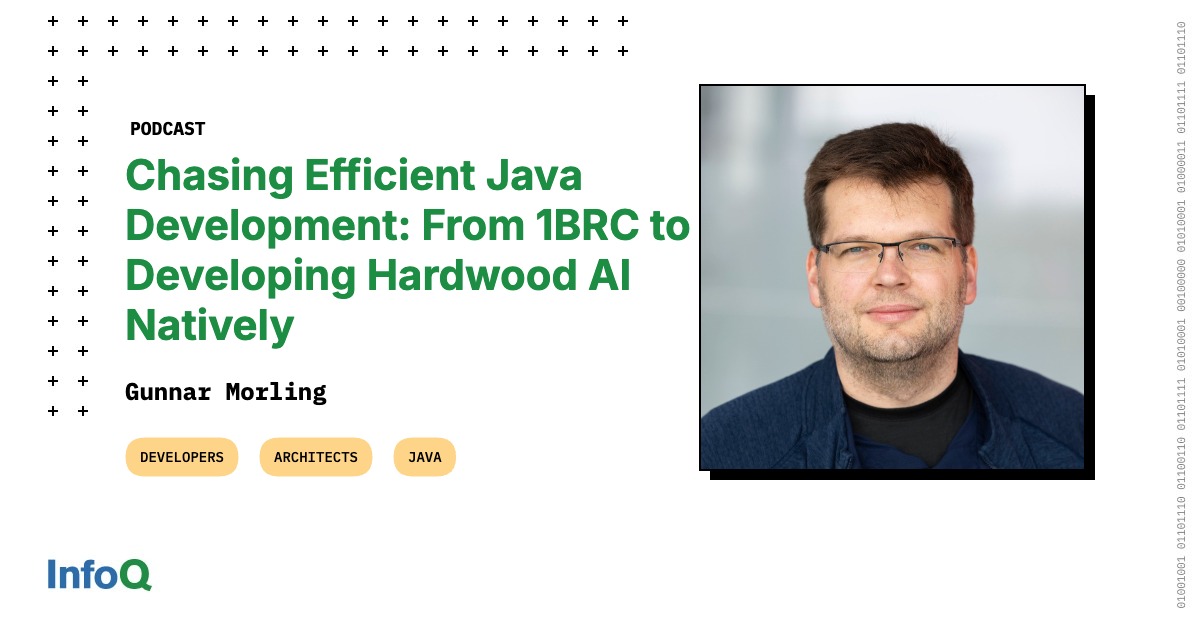
📖 Source: Podcast: Chasing Efficient Java Development: From 1BRC to Developing Hardwood AI Natively
Related Articles
Comments (0)
No comments yet. Be the first to comment!