
GPT-Live: OpenAI's Real-Time Voice Architecture Revealed

Alps Wang
Sep 3, 2026 · 1 views
The Art of Real-Time AI Voice
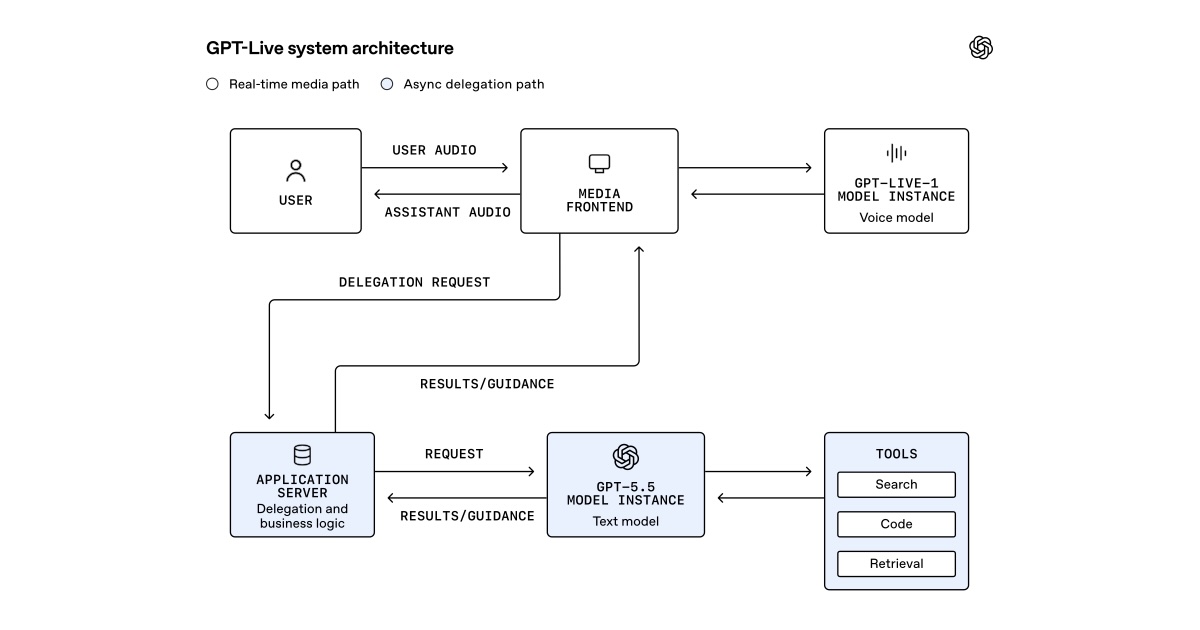
OpenAI's engineering account of GPT-Live presents a compelling solution to the inherent challenges of continuous, stateful voice interaction in AI systems. The core innovation lies in the strict separation of the latency-sensitive media path from broader application logic via an asynchronous RPC boundary. This architectural decision is crucial for maintaining responsiveness, a critical factor for user experience in real-time applications. By confining the media pipeline and inference loop to the 'live path,' OpenAI ensures that delays introduced by external services, tool use, or persistence operations do not disrupt the flow of conversation. The concept of dedicated, stateful inference per session, coupled with the ability for session context to migrate, is a clever approach to balancing dedicated resources with scalability and fault tolerance. This allows for efficient capacity management while ensuring session continuity even during instance draining or context limit breaches. The retention and enhancement of WebRTC, with WARP and Instant Connect, demonstrate a pragmatic approach to leveraging established, low-latency media transport while addressing specific performance bottlenecks. This avoids the potentially higher risk and complexity of adopting entirely new, less mature transport standards for such a critical application. The 'silent test' methodology is particularly noteworthy, offering a realistic validation of system performance under production-like conditions without impacting user experience. This approach is far more insightful than traditional synthetic load testing, uncovering subtle load-related behaviors and geographical performance discrepancies that could have gone unnoticed otherwise.
However, while the article highlights the technical sophistication of GPT-Live, some limitations and concerns warrant consideration. The reliance on dedicated, stateful inference per session, while beneficial for immediate responsiveness, could present challenges in terms of resource utilization and cost at extreme scales, especially if sessions are short-lived or sporadically active. The complexity of managing session context migration, though elegantly handled, adds an operational overhead that requires robust infrastructure and monitoring. The article also mentions the need to 'rethink how to feed voice data to our safety systems,' hinting at potential complexities in integrating comprehensive safety protocols within a high-throughput, low-latency pipeline. While WebRTC is a mature standard, its continued reliance and enhancement might also represent a trade-off against exploring potentially more performant or feature-rich emerging protocols in the long run. The operational trade-offs of maintaining and optimizing a custom WebRTC stack, even with WARP improvements, are significant. Ultimately, GPT-Live is a testament to sophisticated engineering, addressing a critical problem for the next generation of AI-powered voice interfaces. It's a significant step forward for real-time AI, offering valuable lessons for developers building similar interactive systems. The primary beneficiaries are developers and organizations aiming to deploy highly responsive, voice-first AI applications, particularly in areas like virtual assistants, real-time translation, and interactive customer service. The technical implications are profound, pushing the boundaries of what's possible in terms of latency, state management, and reliable media processing for AI.
Key Points
- GPT-Live separates latency-sensitive media processing from broader application logic using an asynchronous RPC boundary.
- The 'live path' handles the media pipeline and inference loop, ensuring continuous voice flow.
- Application logic, delegation, and tool use operate asynchronously behind the RPC boundary.
- Dedicated, stateful inference is used per session, with session context migration for scalability and resilience.
- WebRTC is retained and enhanced with WARP (SPED, DTLS 1.3, SNAP) and Instant Connect to reduce startup latency.
- A 'silent test' using authentic production traffic identified load-related issues missed by synthetic tests.
📖 Source: OpenAI Details GPT-Live’s Architecture for Continuous Stateful Voice Interaction
Related Articles
Comments (0)
No comments yet. Be the first to comment!