
Google's UCP: AI-Powered Commerce Revolution

Alps Wang
Jan 20, 2026 · 1 views
Deciphering the UCP Blueprint
The Universal Commerce Protocol (UCP), spearheaded by Google and backed by major retail players, presents a compelling vision for agentic commerce. The core innovation lies in its open standard approach, enabling AI agents to seamlessly navigate the entire shopping journey, from product discovery to post-purchase management. The modular design, separating payment instruments and processors, and the adoption of standard APIs are significant steps towards creating a more secure and interoperable e-commerce ecosystem. The involvement of key players like Shopify, Etsy, and major payment providers lends credibility and suggests a high probability of adoption. However, a key limitation is the reliance on participating retailers. The success of UCP hinges on widespread adoption, which could be slow, especially for smaller businesses lacking the resources for integration. Furthermore, the article provides limited details on the security architecture beyond tokenization; a deeper dive into how UCP mitigates potential vulnerabilities would be beneficial.
While the concept of agentic commerce is promising, the article's focus on U.S. retailers initially, and expansion plans to emerging markets like India, Indonesia, and Latin America, raise the question of equitable access. Ensuring that UCP is truly universal, and doesn't create further digital divides, is critical. The long-term success of UCP also depends on its ability to handle complex scenarios like returns, refunds, and customer service integration. The protocol's reliance on business profiles could also become a bottleneck if not managed effectively. The article also lacks detailed information on the agent's capabilities, leaving room for a deeper understanding of the agent's intelligence, decision-making, and interaction with various business backends.
Technically, UCP's use of standard APIs and agent-focused bindings is noteworthy. However, the details of the Agent2Agent and Model Context Protocol (MCP) bindings remain somewhat opaque, requiring further investigation. The Python server and SDK implementations are a good starting point, but the developer community will need comprehensive documentation and robust support to build applications on this platform. The success of UCP also depends on the efficiency of the agents and the underlying infrastructure. The scalability and performance of the system will be crucial to handling the large volume of transactions. The separation of payment instruments and processors is crucial for compliance with various regulations.
Key Points
- UCP is an open standard designed for agentic commerce, enabling AI agents to handle the entire shopping process.
- It separates payment instruments and processors, promoting security and supporting multiple providers.
- The protocol supports standard APIs and agent-focused bindings for conversational interfaces.
- Co-developed with major retailers and payment providers, increasing its likelihood of adoption.
- Early implementations are in Google Search and Gemini app, with expansion planned for international markets.
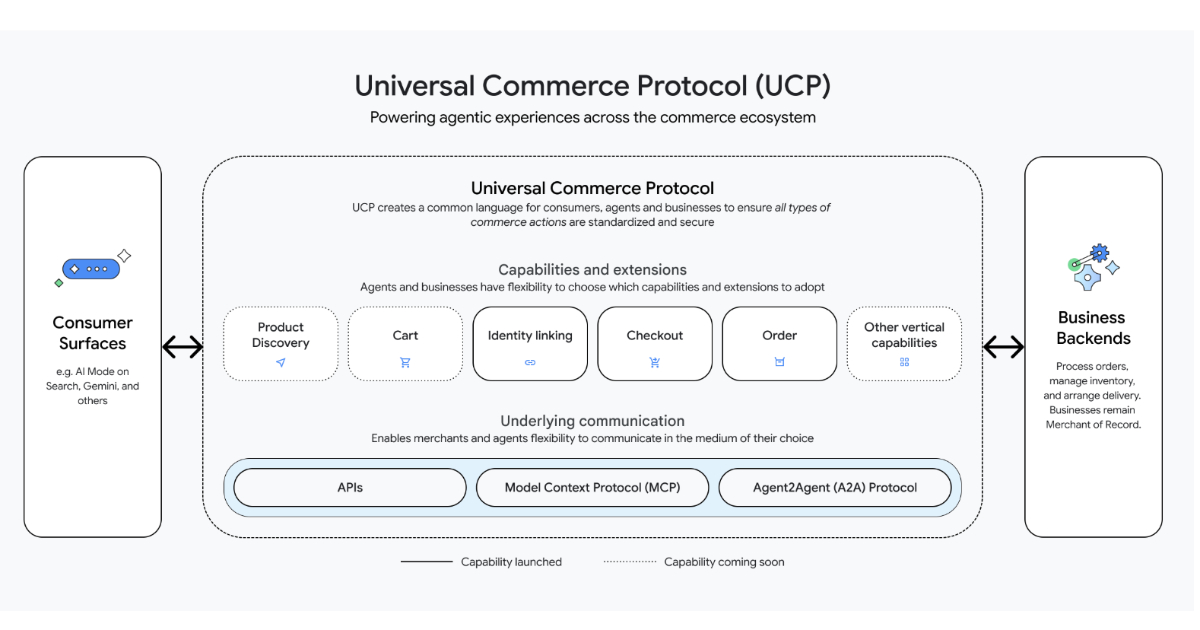
📖 Source: Google and Retail Leaders Launch Universal Commerce Protocol to Power Next‑Generation AI Shopping
Related Articles
Comments (0)
No comments yet. Be the first to comment!