
GitHub Boosts Issues Navigation: Client-Side Overhaul

Alps Wang
Jul 23, 2026 · 1 views
Client-Side Dominance: GitHub's Latency War
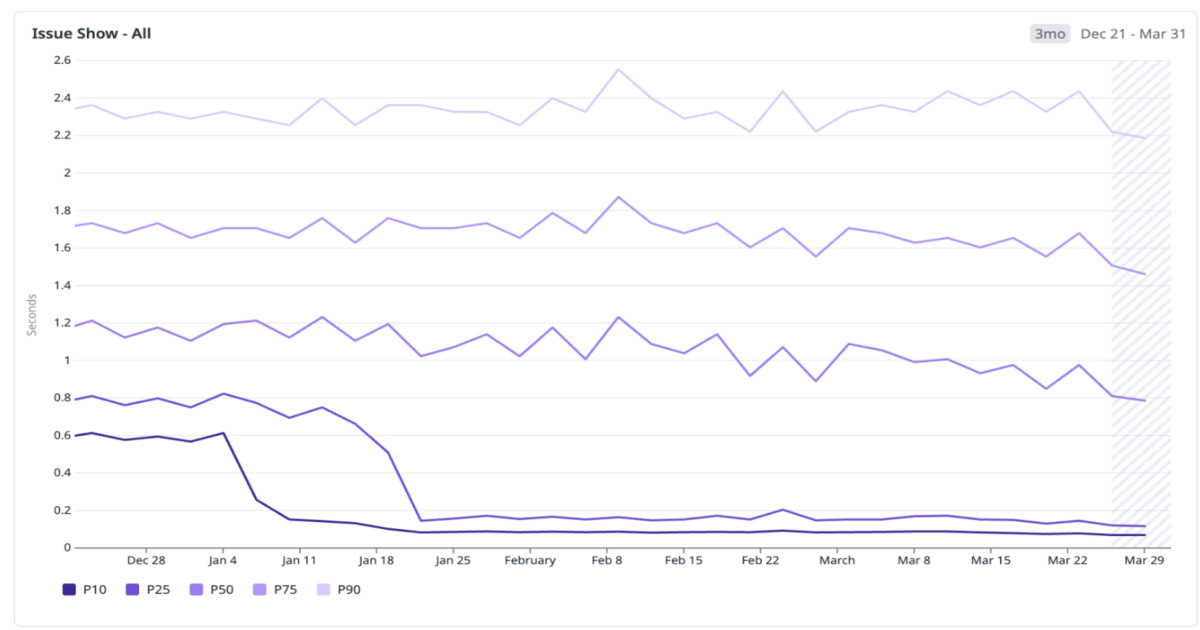
GitHub's deep dive into optimizing the client-side architecture for GitHub Issues showcases a sophisticated approach to tackling perceived latency. The shift towards a 'local-first' strategy, leveraging IndexedDB for persistent storage and in-memory caching for active sessions, is a powerful demonstration of how modern web applications can defer backend dependencies. The introduction of service workers for request handling and the stale-while-revalidate caching model are particularly noteworthy, enabling immediate UI rendering while asynchronously updating data. This directly addresses the pain point of repeated network requests in frequent workflows, a common challenge in large-scale platforms. The article effectively highlights that this isn't just about raw speed, but about context switching and user perception, a critical distinction for developer experience.
However, while the gains are impressive (4% to 22% instant navigation), the article hints at the complexities. The distinction made by BareStack regarding prefetching and data graph size is crucial. For highly interconnected or write-heavy data, prefetching might lead to more cache invalidation and refetches. The reusable pattern of 'shell-first render + cache-hit hydration' is a more robust takeaway than aggressive prefetching. Furthermore, the article touches on balancing responsiveness with data freshness. While GitHub's approach reduces user waiting time, the potential for stale data to be displayed, even if asynchronously updated, could be a concern for certain critical workflows or users demanding absolute real-time accuracy. The engineering maturity lies in managing this trade-off effectively, moving from p99 tail optimization to overall distribution quality, as Oguz Guven points out. This strategy is most beneficial for developers working on applications with frequent, predictable navigation patterns and read-heavy data structures.
Key Points
- GitHub significantly improved instant navigation for GitHub Issues from 4% to 22% by rethinking its client-side architecture.
- Key strategies include client-side caching (IndexedDB, in-memory), predictive prefetching, and service worker-based request handling.
- A 'local-first' approach renders data immediately from the browser while background processes fetch newer information.
- The caching model uses 'stale-while-revalidate' for quick UI display and asynchronous updates.
- 'Preheating' prepares likely required data before user requests, enhancing cache effectiveness.
- Service workers intercept requests, serving cached data when available and falling back to the backend when necessary.
- The focus shifted from optimizing worst-case latency (p99) to improving overall distribution quality.
- The approach is particularly effective for read-heavy data graphs with predictable navigation patterns.
📖 Source: GitHub Increased Instant Navigation from 4% to 22% by Rethinking Client Side Architecture
Related Articles
Comments (0)
No comments yet. Be the first to comment!