
Gemini CLI: AI-Powered Outage Response for Google Cloud

Alps Wang
Feb 15, 2026 · 1 views
AI-Driven Incident Response Evolution
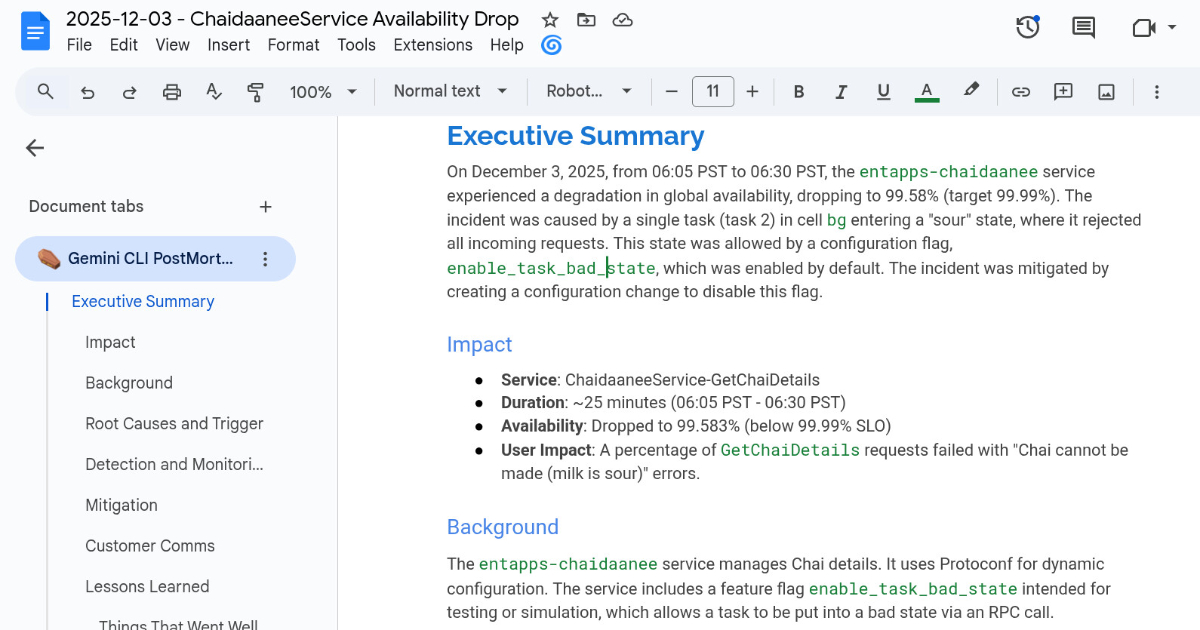
The article from InfoQ provides a compelling look at how Google Cloud SREs are leveraging the Gemini CLI to streamline outage response. The core innovation lies in integrating an AI agent, built on Gemini 3, directly into the terminal, allowing SREs to classify incidents, suggest mitigations, perform root-cause analysis, and generate postmortems. This approach promises significant improvements in Mean Time to Mitigation (MTTM), a crucial metric for maintaining service availability. The use of 'mitigation playbooks' and the emphasis on human-in-the-loop validation are particularly interesting, showcasing a pragmatic approach that balances AI assistance with operator control. The postmortem generation feature, coupled with the feedback loop for training the AI, creates a virtuous cycle of improvement, potentially leading to more efficient and effective incident resolution over time.
However, there are limitations and concerns. The article highlights that the examples are Google-internal tools, implying that directly replicating this solution requires access to similar internal systems and integrations. While the 'pattern is universal,' the implementation details and the availability of the necessary components (like the Gemini CLI itself) for external users are unclear. The reliance on human validation, while prudent, could potentially slow down the mitigation process if the validation step becomes a bottleneck. Furthermore, the article doesn't delve deeply into the complexity of building and maintaining these AI-powered playbooks, the potential for incorrect or misleading AI suggestions, or the security implications of granting an AI agent access to operational tools. The article suggests using custom slash commands, but does not provide an in-depth look at how these are constructed or how they interface with the Gemini CLI. Finally, while the article touches upon the concept of 'agentic safety systems', it doesn't give examples of how these are implemented, and this lack of detail is a substantial omission given the importance of safety in operational contexts. The scope for customisation and integrations also is not discussed.
This technology would primarily benefit SREs, DevOps engineers, and anyone responsible for maintaining the reliability of cloud-based services. Companies that are already heavily invested in Google Cloud and have the internal expertise to develop and integrate custom tools would likely be the earliest adopters. The technical implications are significant. This represents a trend toward AI-assisted operations, and the successful implementation of such systems could dramatically change how incidents are handled. The comparison with existing solutions is not explicitly detailed in the article, but it is clear that this offers an advantage over manual incident response and could surpass the capabilities of existing automated incident management tools that may rely on static rules or limited automation. The 'virtuous loop' aspect (using postmortems to improve the AI) is particularly compelling and a key differentiator.
Key Points
- Gemini CLI, built on Gemini 3, assists Google Cloud SREs in outage response, improving MTTM.
- The CLI helps in all phases: classification, mitigation, root cause analysis, and postmortem generation.
- Mitigation playbooks are created dynamically with human-in-the-loop validation.
- Postmortems become training data, creating a self-improvement loop.
- Requires custom commands and integration with tools like Grafana and PagerDuty.
📖 Source: From Paging to Postmortem: Google Cloud SREs on Using Gemini CLI for Outage Response
Related Articles
Comments (0)
No comments yet. Be the first to comment!