
Gemini 4 Argon: AI for Complex Tasks

Alps Wang
Oct 28, 2026 · 1 views
Gemini 4 Argon: A Leap in AI Capabilities
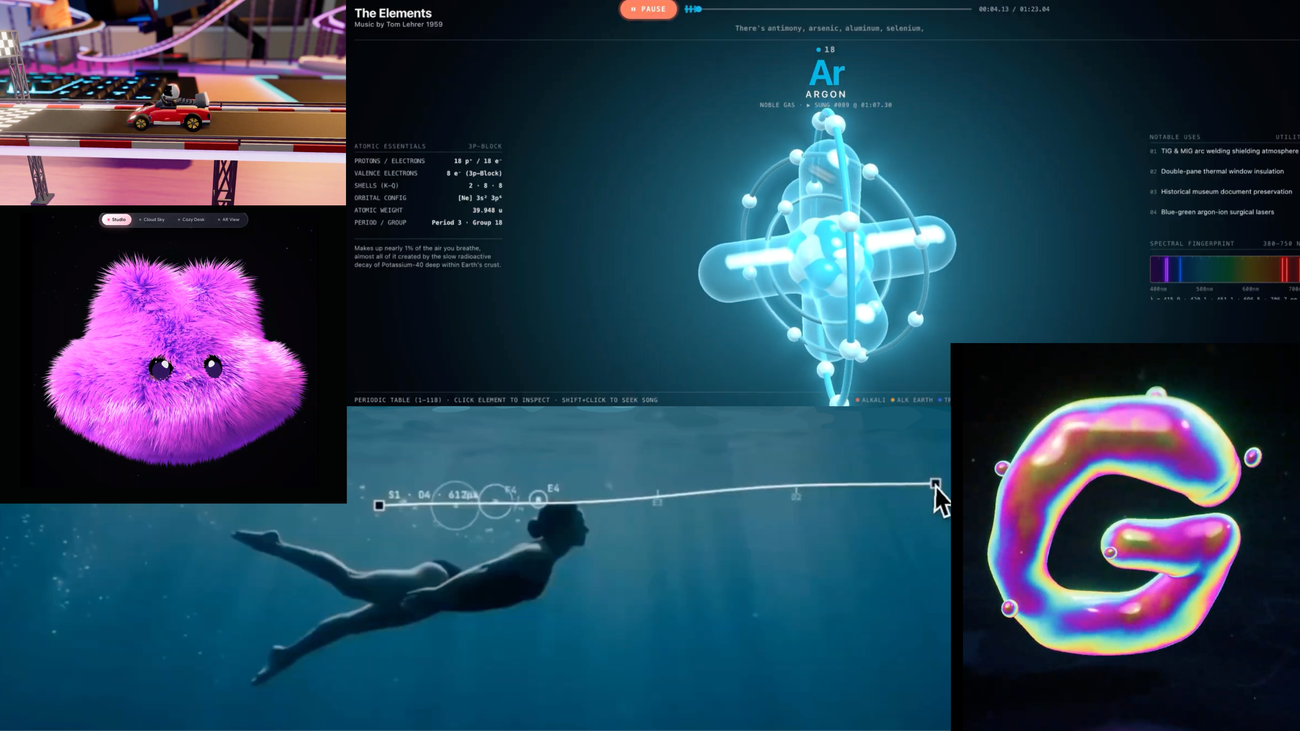
The Google Gemini Blog post introduces Gemini 4 Argon as a revolutionary AI model capable of tackling highly complex, multi-step tasks, from rendering 3D environments from scratch to orchestrating complex sub-agents for game development and data analysis. The examples provided, such as generating 5,000 lines of math for a 3D library, creating interactive audiovisual tools, and processing vast NASA datasets into executive-ready presentations, showcase a significant leap in AI's reasoning, coding, and multimodal integration capabilities. The emphasis on turning 'months of complex work into minutes of execution' highlights a potential paradigm shift in productivity for developers, researchers, and creative professionals. The availability across various Google platforms and APIs suggests a broad integration strategy, aiming to democratize access to these advanced AI functionalities. The article effectively positions Argon as a tool for 'solving your hardest problems,' moving beyond simple content generation to deep task execution and orchestration.
However, the article leans heavily on illustrative examples without delving into the underlying technical architecture or performance benchmarks that would allow for a more rigorous evaluation. While 'frontier reasoning,' 'deep visual perception,' and 'expanded knowledge' are mentioned, concrete details on how these are achieved or quantified are absent. The reliance on proprietary tools like 'Antigravity,' 'Blender MCP,' and 'Nano Banana' also raises questions about the true independence of Argon versus its dependence on an ecosystem of specialized internal tools. Furthermore, the claim of 'months of manual effort' being reduced to 'minutes' requires substantiation; without comparative data or independent verification, these claims remain aspirational. The 'experimental' label for generative AI, though standard, still implies potential for unpredictable outputs or biases, which are not addressed. For a tech industry analyst, more information on the model's architecture, training data scale, specific performance metrics (e.g., latency, accuracy on benchmark tasks), and safety/ethical considerations would be crucial for a comprehensive assessment of its true impact and limitations.
Key Points
- Gemini 4 Argon is Google's most advanced AI model, designed for complex, multi-step tasks.
- It excels in deep comprehension, long-horizon workflows, reasoning, coding, and tool coordination.
- Examples showcase its ability to generate complex 3D environments, create interactive audiovisual tools, and process large datasets into executive reports.
- The model integrates advanced reasoning, visual perception, expanded knowledge, and writing capabilities.
- It can generate lifelike textures, including studio-grade fur dynamics, and create interactive physics simulations.
- Gemini 4 Argon is available globally via API, AI Studio, Gemini platform, and within Google Antigravity and the Gemini app.
📖 Source: 8 examples of Gemini 4 Argon in action
Related Articles
Comments (0)
No comments yet. Be the first to comment!