
Dropbox AI Bridges Security Design & Code Review

Alps Wang
Aug 1, 2026 · 1 views
Context-Aware Engineering at Scale
Dropbox's integration of MCP and Dash represents a crucial step in operationalizing AI to bridge the persistent gap between security design and code implementation. The core innovation lies in transforming static security documentation into dynamic, context-aware inputs for developer workflows. By surfacing relevant threat models and security requirements directly within the pull request interface, they significantly reduce context switching and improve the likelihood that security intent is maintained throughout the development lifecycle. This approach is particularly noteworthy for its emphasis on augmenting, rather than automating, security decisions, thereby fostering developer trust and preserving human judgment. The focus on traceability and developer feedback further solidifies its potential for robust adoption and continuous improvement.
However, a key limitation to consider is the inherent challenge of maintaining the accuracy and relevance of the underlying data sources within Dash. As systems evolve, ensuring that threat models and design documents remain up-to-date and accurately reflect the codebase is a continuous operational burden. While semantic retrieval helps, the effectiveness of the system will ultimately hinge on the quality and recency of the information indexed. Furthermore, the success of this initiative is deeply tied to the organizational culture and the willingness of engineers to engage with AI-assisted context. While Dropbox aims to make it harder for requirements to disappear, the ultimate responsibility for security still rests with the human reviewer. The system's effectiveness in preventing security oversights is therefore contingent on both its technical accuracy and the human element's diligent utilization of its insights. The ambition to extend this pattern to compliance, privacy, and API governance is promising, but each new domain will present its own unique data challenges and require careful adaptation of the retrieval and reasoning mechanisms.
Key Points
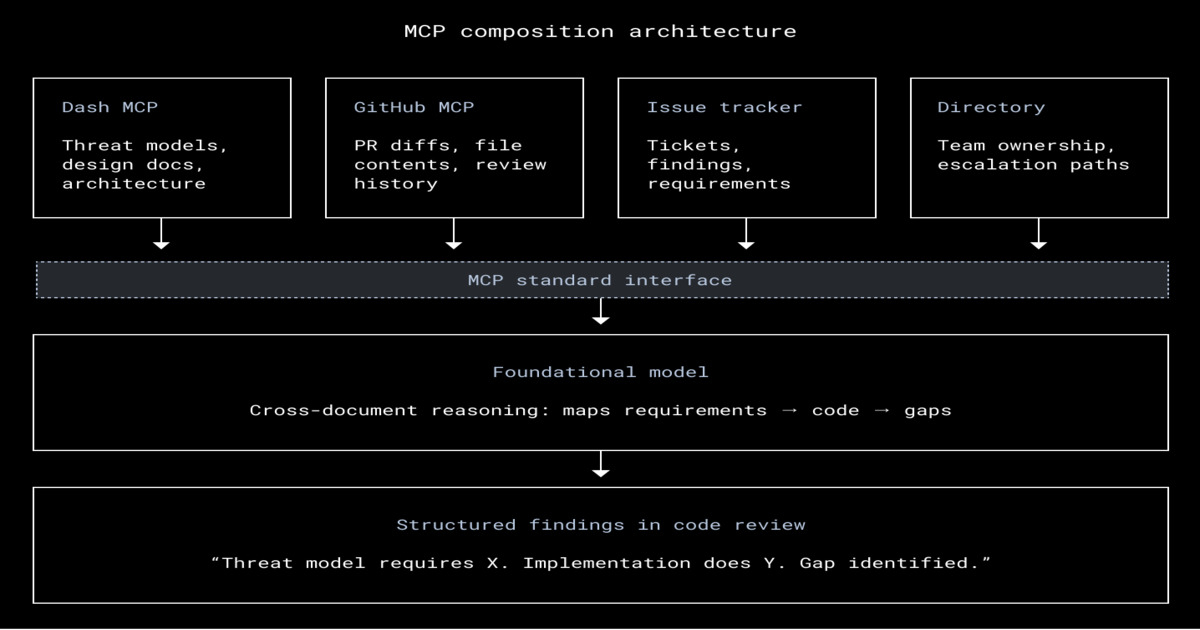
- Dropbox is integrating its internal knowledge system, Dash, with the Model Context Protocol (MCP) to connect security design artifacts directly with code review workflows.
- The goal is to address the gap where security requirements are defined in design but often lost or disconnected during code review.
- Dash acts as a centralized, permission-aware indexing and retrieval layer for organizational knowledge.
- MCP enables AI systems to retrieve and utilize this context within developer workflows, such as code reviews.
- The system surfaces relevant threat models and security requirements within the pull request interface, reducing context switching.
- The emphasis is on augmenting human reviewers by providing context, not automating security decisions.
- Key design principles include traceability, assisting reviewers rather than replacing them, and leveraging developer feedback for continuous improvement.
- Challenges include retrieving the right context, ensuring relevance and specificity, and maintaining developer trust through accurate and actionable findings.
- The integration pattern is designed to be reusable for other governance-focused workflows like compliance and API governance.
- The overarching lesson is that enterprise AI is most valuable when grounded in existing organizational decisions and knowledge, preserving institutional memory.
📖 Source: Dropbox Integrates MCP and Dash to Close the Gap Between Security Design and Code Review
Related Articles
Comments (0)
No comments yet. Be the first to comment!