
Disaggregated Databases: The Cloud's Next Evolution

Alps Wang
Jul 31, 2026 · 1 views
The Economics of Elasticity
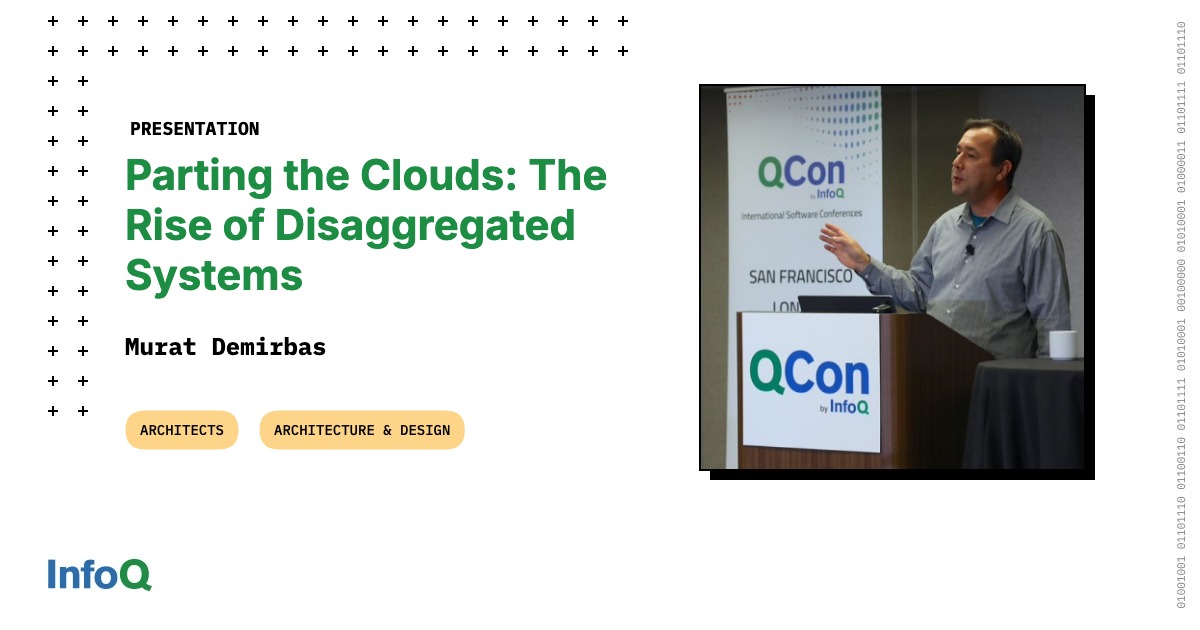
Murat Demirbas' presentation 'Parting the Clouds: The Rise of Disaggregated Systems' provides a compelling argument for the shift towards disaggregated database architectures, primarily driven by cloud economics. The core insight is the fundamental impedance mismatch between compute and storage: compute is expensive, volatile, and stateless, while storage is cheap, stable, and stateful. Tightly coupling them in traditional architectures leads to inefficiencies and higher costs, as scaling one necessitates scaling the other. Disaggregation, by decoupling these resources, allows for independent, elastic scaling, pay-per-use models, and improved fault isolation. The presentation effectively illustrates this through real-world examples like Amazon Aurora and Alibaba PolarDB, highlighting how network advancements have made this separation feasible. The historical context, drawing parallels to Paxos, adds a unique perspective, suggesting that the underlying principles of distributed coordination have long supported such architectural patterns.
What's particularly noteworthy is the focus on operational benefits beyond just cost savings, such as faster recovery and simplified management. The exploration of different disaggregation strategies, like splitting storage into Log Stores and Page Stores (as seen in TaurusDB), demonstrates a maturing understanding of how to optimize this architecture. The idea that 'the data center is the new computer' with the network as its backplane is a powerful metaphor for the interconnectedness and potential of these systems. The presentation also touches upon the ongoing challenges and future directions, such as the evolution of shared-memory technologies and self-assembling database designs, indicating that this is an active and evolving field.
However, while the benefits are clearly articulated, a deeper dive into the specific network latency trade-offs and the complexity introduced by managing these distributed components could be beneficial. The reliance on high-speed networks is critical, and any degradation in network performance could significantly impact application responsiveness. Furthermore, the 'surgery' required to adapt existing monolithic databases (like early Aurora implementations) to disaggregated models, as mentioned, highlights potential integration challenges and the ongoing effort required to maintain these systems. The presentation is primarily aimed at experienced technical professionals, and while it simplifies complex topics, a novice might find some of the specific database internals challenging to grasp without prior knowledge. Despite these points, the overall message about the inevitability and advantages of disaggregated systems in the cloud is strong and well-supported.
Key Points
- The primary driver for disaggregated cloud database architectures is cloud economics, stemming from the impedance mismatch between compute (costly, volatile, stateless) and storage (cheap, stable, stateful).
- Decoupling compute from storage enables elastic scaling (up and down), pay-per-use models, cost efficiency through I/O pooling, and improved fault isolation.
- Modern high-speed networks (hundreds of Gbps), RDMA, SmartNICs, and CXL are crucial enablers for disaggregation.
- Disaggregated databases are already prevalent, with examples like Amazon Aurora, Alibaba PolarDB, and Google AlloyDB.
- Key architectural patterns involve stateless compute nodes, shared storage, and the network replacing local I/O, often utilizing the log as the primary data source.
- Different approaches exist for materializing data at the storage tier, ranging from modifying database engines to using distributed file systems.
- Historical distributed coordination protocols like Paxos foreshadowed the principles behind disaggregation.
- Future directions include shared-memory evolution and self-assembling database designs.
📖 Source: Presentation: Parting the Clouds: The Rise of Disaggregated Systems
Related Articles
Comments (0)
No comments yet. Be the first to comment!