
Deloitte Slashes EKS Testing Time by 89%

Alps Wang
Apr 28, 2026 · 1 views
Virtual Clusters, Real Gains
Deloitte's adoption of vCluster with Amazon EKS offers a compelling solution for optimizing Kubernetes testing environments, particularly for large enterprises grappling with the operational overhead and cost of managing numerous dedicated clusters. The dramatic 89% reduction in environment provisioning time, coupled with significant resource consolidation and cost savings (up to 70% on EC2 Spot Instances), highlights the tangible benefits of this architectural pattern. The ability for QA teams to self-provision environments in under 5 minutes without platform team intervention is a critical de-bottlenecking achievement, directly impacting development velocity and team autonomy. The shared controller model also elegantly addresses resource duplication, simplifying management and reducing the overall complexity of the Kubernetes ecosystem.
While the article effectively showcases the benefits, it would be beneficial to explore potential limitations or edge cases. For instance, the article mentions "shared controllers" running on the host cluster. Understanding the specific controllers and their resource consumption on the host cluster is important, as an overloaded host cluster could negatively impact the performance of all virtual clusters. Furthermore, while vCluster abstracts away much of the complexity, a deeper dive into the security implications of shared infrastructure and how RBAC is managed across host and virtual clusters would be valuable for organizations with stringent security requirements. The article focuses on QA testing; exploring its applicability to other use cases, such as CI/CD pipelines or even production environments (though less likely given the focus), could further broaden its impact. The reliance on a specific version of vCluster-platform (4.0.1) in the walkthrough suggests a need for careful version management and upgrade strategies.
This solution is highly beneficial for organizations with significant QA testing needs on Kubernetes, especially those experiencing slow provisioning times, high infrastructure costs, and platform team bottlenecks. It empowers development and QA teams with rapid access to isolated, functional environments without the burden of full cluster management. Companies operating at scale, managing dozens or hundreds of development and testing environments, stand to gain the most from this approach. The technical implications are substantial, pointing towards a more efficient and scalable model for Kubernetes resource utilization, moving away from a one-cluster-per-need paradigm towards a more shared, virtualized infrastructure model within the cloud provider's managed Kubernetes service.
Key Points
- Deloitte reduced Amazon EKS testing environment provisioning time by 89% (from 30-45 minutes to under 5 minutes) using vCluster.
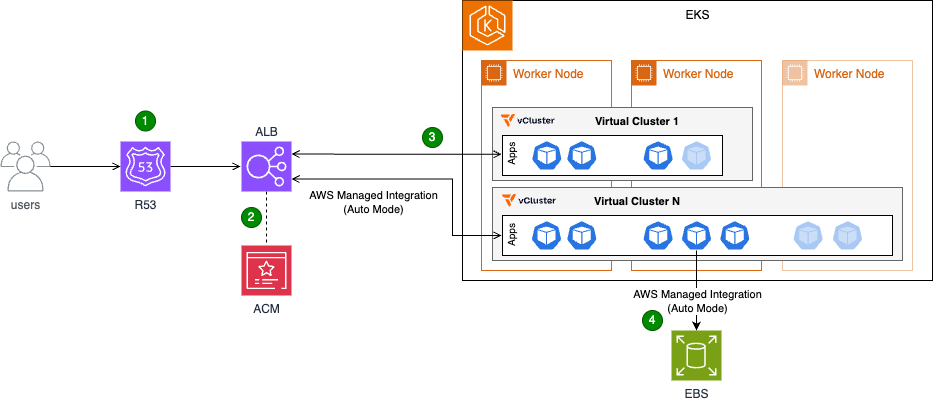
- The solution consolidates multiple ephemeral testing environments into lightweight, fully functional virtual clusters running on a single EKS host cluster.
- Key benefits include significant cost savings (up to 70% on EC2 Spot Instances), reduced infrastructure duplication (shared controllers like ingress and monitoring agents), and improved platform team efficiency.
- QA teams can now self-provision their own testing environments, fostering greater autonomy and accelerating development cycles.
- The architecture leverages shared platform services on the host cluster, minimizing resource overhead per virtual cluster.
Related Articles
Comments (0)
No comments yet. Be the first to comment!