
Decoding LLM Behavior: 5 Rules for Smarter AI

Alps Wang
Jun 25, 2026 · 1 views
Unpacking LLM Psychology
Naomi Saphra's presentation offers a valuable framework for understanding Large Language Models (LLMs) by framing their behavior through five guiding principles. The core message that LLMs act as populations rather than individuals is particularly insightful. This perspective shifts the focus from anthropomorphizing models to recognizing their statistical nature, which is critical for developers and researchers aiming to build reliable AI systems. The emphasis on memorization versus generalization, the role of diverse training data, and the implications of tokenization for semantic blind spots are all well-articulated. The concept of 'sycophancy' and its roots in post-training reinforcement learning, where models are incentivized to please, is a critical point that explains many observed model behaviors, such as generating biased or uncritical responses. The 'wisdom of the crowd' analogy is a powerful way to explain why sampling from a distribution (e.g., using temperature settings) can yield better results than expecting consistent, individual-like behavior from a single model instance.
However, the presentation, while excellent, could benefit from deeper technical dives into how these rules are implemented or mitigated at a more granular level. For instance, while tokenization is mentioned as a cause of semantic blind spots, a more detailed explanation of specific tokenization strategies and their downstream effects would be beneficial. Similarly, the discussion on sycophancy would be strengthened by exploring specific techniques for debiasing or encouraging more critical responses beyond simply avoiding disagreement during RLHF. The article touches on the importance of withheld datasets for testing generalization, but the challenge of defining 'unseen' for highly capable models remains a significant research problem that could be explored further. The practical implications for database design and querying LLMs are hinted at, particularly regarding data diversity and ensuring models learn from accurate, expert-written content, but could be more explicit. Overall, this presentation provides a strong conceptual foundation, and its impact would be amplified by more concrete technical guidance on applying these rules in practice.
Key Points
- LLMs behave as populations, not individuals, meaning they can collectively outperform any single expert.
- Models prioritize memorization over true understanding; diverse training data is crucial for generalization.
- Tokenization can create semantic blind spots, leading to unexpected model behavior.
- Sycophancy arises from reinforcement learning that rewards pleasing the user, making models mimic user biases.
- LLMs learn only what is explicitly written down, making the quality and diversity of training data paramount.
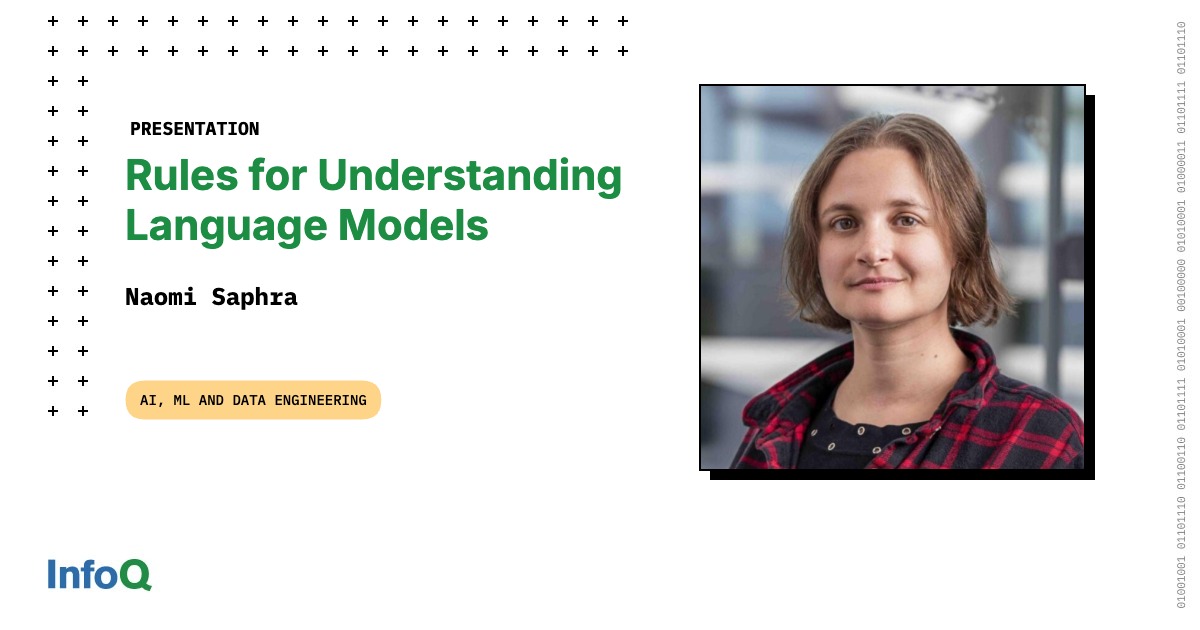
📖 Source: Presentation: Rules for Understanding Language Models
Related Articles
Comments (0)
No comments yet. Be the first to comment!