
DBOS: Workflows Inside Your Database

Alps Wang
Jul 24, 2026 · 1 views
Database as Orchestrator
The core innovation presented by DBOS Transact is the compelling argument for treating workflow execution state as data, leveraging the inherent strengths of databases for durability and fault tolerance. By consolidating orchestration logic within the database, rather than relying on external, often brittle orchestrators, DBOS aims to simplify complex distributed systems, particularly those involving AI. This approach promises reduced latency, enhanced reliability, and a more unified operational model. The key insight is that databases, with their decades of development in handling state, transactions, and recovery, are exceptionally well-suited for managing the lifecycle of workflows, a task often shoehorned into less appropriate external systems.
This architecture is particularly noteworthy for its potential to address the growing pains of AI-driven applications. As AI models become more integrated into business processes, the need for robust, fault-tolerant, and observable workflows becomes paramount. The DBOS approach offers a path to achieve this without the traditional overhead of separate orchestration infrastructure. By using standard database features like tables, SKIP LOCKED queues, and unique primary keys, the solution leverages existing, well-understood technologies. The ability to recover from failures by resuming execution from the last checkpoint, rather than restarting entirely, is a significant advantage for long-running or expensive AI tasks.
However, potential limitations and concerns warrant consideration. While the presentation highlights the simplicity of using standard database features, the actual implementation of robust workflow logic within a database can still be complex. The effectiveness of this approach will heavily depend on the underlying database's performance characteristics, particularly for high-throughput scenarios. Furthermore, the 'database as orchestrator' paradigm might introduce a steeper learning curve for developers accustomed to traditional orchestration tools. The tight coupling of workflow logic with the database might also present challenges in terms of database schema evolution and migration strategies. Vendor lock-in, while claimed to be reduced compared to external orchestrators, could still be a factor if specific database features or performance optimizations are heavily relied upon. The article also focuses on PostgreSQL, and while the concept is universal, performance and implementation details might vary significantly across different database systems.
Key Points
- Traditional workflow orchestration relies on external systems, increasing complexity and failure points.
- DBOS proposes using the existing database as the central component for workflow execution state and orchestration.
- Workflows are treated as data, leveraging database capabilities for durability, fault tolerance, and exactly-once execution.
- Key database features like tables, SKIP LOCKED queues, and unique primary keys are used to manage workflow state and progress.
- This approach aims to reduce latency, improve reliability, and lower operational overhead compared to external orchestrators.
- DBOS offers open-source libraries for Python, TypeScript, Go, and Java built on PostgreSQL.
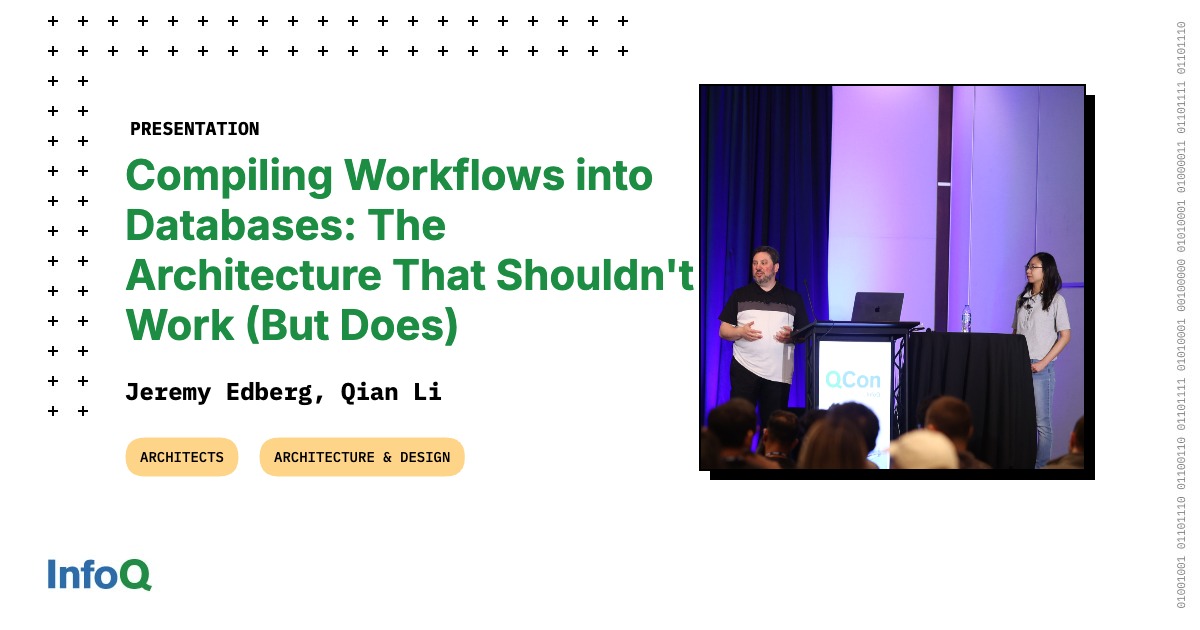
📖 Source: Presentation: Compiling Workflows into Databases: The Architecture That Shouldn't Work (But Does)
Related Articles
Comments (0)
No comments yet. Be the first to comment!