
Cloudflare's 100TB RAM Win: Hashing Gets Lean

Alps Wang
Oct 24, 2026 · 1 views
The Math Behind Massive Scale Savings
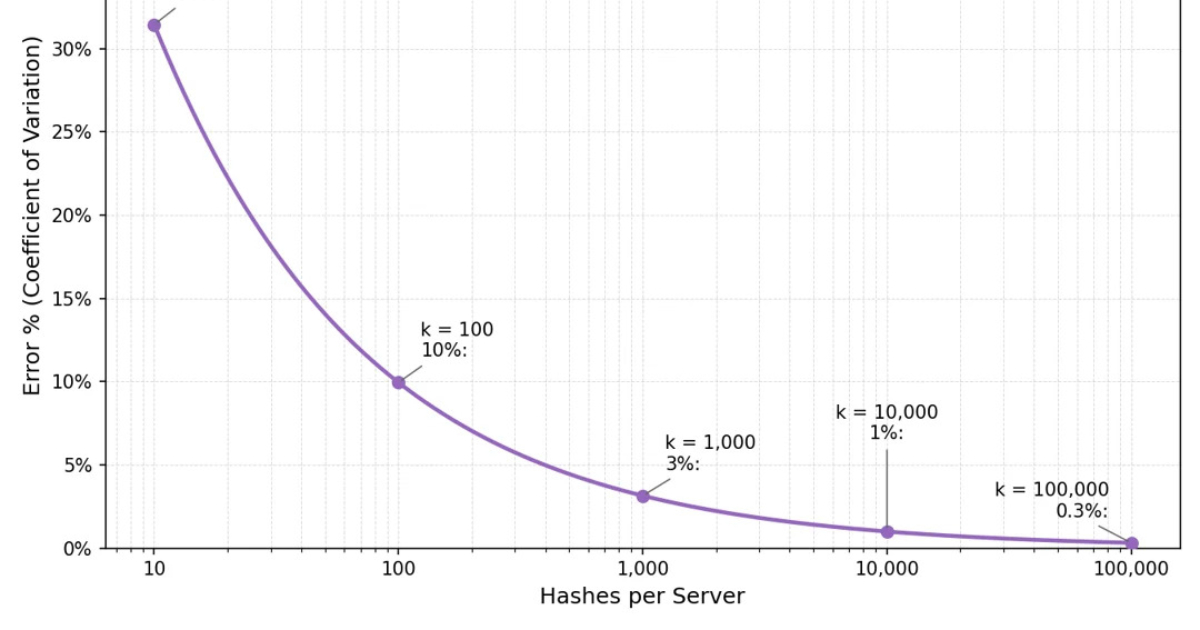
Cloudflare's achievement in reclaiming 100 TB of RAM through the optimization of consistent hashing in their pingora-ketama implementation is a remarkable feat of engineering. The core innovation lies in their application of probability theory and statistical analysis to fundamentally rethink the number of hash points required for effective load balancing. By moving beyond arbitrary or empirically derived numbers of hashes and instead calculating the minimum necessary to meet specific error margins, they were able to drastically reduce memory overhead. This approach, grounded in the birthday paradox and the diminishing returns of adding more hashes, showcases a deep understanding of the underlying algorithms and their practical implications at extreme scale. The optimization of the Rust data structures, reducing the byte footprint of hash ring entries, further amplifies the impact, demonstrating a holistic approach to memory management.
However, while the article highlights the success, it implicitly points to the complexity and potential fragility of such highly optimized systems. The need for a gradual rollout to avoid cache churn underscores the interconnectedness of these distributed systems and the potential for cascading failures if not managed meticulously. The significant memory savings, while impressive, also raise questions about the baseline memory footprint of similar systems in the industry that may not have undergone such rigorous optimization. The success here is a testament to Cloudflare's engineering prowess, but it also serves as a reminder that performance optimization at scale is an ongoing, often intricate, and resource-intensive endeavor. The article could benefit from a more explicit discussion on the trade-offs made beyond memory, such as potential increases in computational complexity for hash calculation itself, though the article implies this was minimized.
Key Points
- Cloudflare reclaimed 100 TB of RAM by optimizing its consistent hashing implementation (pingora-ketama).
- The optimization involved applying probability theory and statistical analysis to determine the minimum number of hash points needed, reducing them by approximately 90%.
- This was achieved by analyzing hash distribution, collision rates, and leveraging concepts like the birthday paradox.
- Further memory savings were realized by optimizing Rust data structures, reducing the byte size of hash ring entries.
- A gradual rollout strategy was crucial to mitigate cache churn and origin traffic spikes.
📖 Source: Cloudflare Reclaims 100 TB of RAM by Optimizing Consistent Hashing
Related Articles
Comments (0)
No comments yet. Be the first to comment!