
Cloud Data Warehouse Billing Unpacked

Alps Wang
May 28, 2026 · 1 views
Demystifying Cloud Data Spend
The ClickHouse Blog's article 'How the 5 major cloud data warehouses really bill you' is a commendable effort to demystify the opaque pricing models of cloud data warehouses. Its primary strength lies in its engineer-centric approach, translating abstract billing units like 'credits' and 'DBUs' into tangible compute costs. By focusing on compute rather than storage, which is often commoditized, the authors correctly identify the core differentiator and source of cost variability. The introduction of the CostBench framework is particularly noteworthy, providing a reproducible method for comparing costs across disparate systems. This transparency is crucial for organizations trying to optimize their cloud analytics spend. The detailed breakdown of each platform's provisioning model, scaling mechanisms (vertical and horizontal), and metering granularity offers valuable insights that are often buried in vendor documentation.
However, a key limitation is the article's reliance on November 2025 pricing, which, while noted, means the information is inherently time-sensitive. Cloud pricing is dynamic, and these figures will inevitably become outdated. Furthermore, while the article aims for a unified comparison, the inherent differences in underlying compute architectures and query engine efficiencies mean that a direct cost-per-query comparison based solely on billing units can still be misleading without a deep understanding of query optimization and workload characteristics. The article acknowledges that query runtimes scale differently and that the same query can consume radically different amounts of compute, but the practical implications of these differences on overall cost are complex and not fully explored beyond the benchmark results. Users will still need to conduct their own workload-specific testing to truly understand their costs. The article also touches upon Snowflake's Interactive warehouses and Databricks' SQL Serverless without fully detailing their nuances beyond minimum billing periods and abstraction levels, which could be further elaborated. Despite these points, the article serves as an excellent starting point for anyone grappling with cloud data warehouse costs.
Key Points
- Cloud data warehouse pricing is complex, with public price lists often being misleading due to differing compute units and execution models.
- The article focuses on compute costs, highlighting them as the primary driver of cost differences, with storage costs being less significant.
- A reproducible framework called CostBench is introduced to translate benchmark runtimes into dollar costs by mapping system pricing models.
- Snowflake uses a provisioned warehouse model where compute is billed per hour based on fixed 'credit' consumption per warehouse size, with scaling affecting costs linearly or via additional clusters.
- Databricks (SQL Serverless) also uses a provisioned model with fixed 'DBU' consumption per warehouse size, with scaling impacting costs similarly to Snowflake.
- ClickHouse Cloud offers flexible node sizing and bills based on 'compute units' derived from RAM and vCPU, with a more granular and potentially cost-effective model.
- Google BigQuery's serverless model bills based on query processing (bytes processed) and compute time, with options for on-demand or flat-rate pricing, and its autoscaling is a key cost factor.
- Amazon Redshift Serverless bills based on 'RPUs' (Redshift Processing Units) consumed per second, with auto-scaling and auto-resume features impacting cost, and its pricing is tied to RPU-seconds.
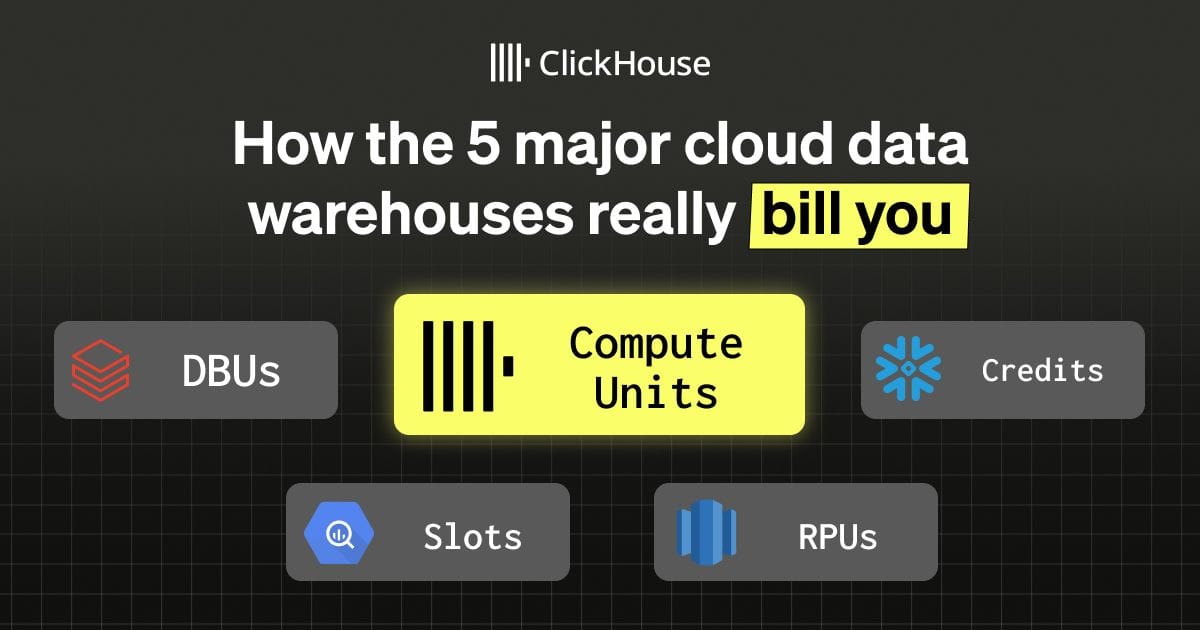
📖 Source: How the 5 major cloud data warehouses really bill you: A unified, engineer-friendly guide
Related Articles
Comments (0)
No comments yet. Be the first to comment!