
ClickHouse Cloud: Index Sharding for Petabyte Scale

Alps Wang
Apr 22, 2026 · 1 views
Unlocking Petabyte Scale Performance
The introduction of index sharding in ClickHouse Cloud is a crucial advancement for handling truly massive datasets. By distributing index analysis across replicas, ClickHouse effectively tackles the memory overhead and computational bottleneck that arises when indexes become prohibitively large. The core insight – that each replica no longer needs to hold the entire index – fundamentally alters the economics of scaling. This is particularly impactful for workloads leveraging secondary indexes like vector search and full-text search, where index analysis can dominate query costs. The demonstrated performance gains, up to 7.7x in benchmarks, highlight the tangible benefits of this architectural shift. The fallback mechanism to local analysis in case of transient failures also adds robustness to the distributed approach.
However, the article could benefit from a more detailed discussion on the operational overhead and complexity introduced by index sharding. While the benefits are clear, understanding the management of index partitions, potential rebalancing strategies, and the implications for data ingestion and consistency during shard reassignments would be valuable for practitioners. Furthermore, while the article mentions 'virtual hash ring' and 'consistent hashing,' a deeper dive into how these are implemented and managed within ClickHouse Cloud's infrastructure would be beneficial for a purely technical audience. The current explanation, while illustrative, might leave some engineers wanting more granular implementation details. Finally, a clearer articulation of the specific thresholds or conditions under which index sharding becomes a significant advantage, beyond just 'large tables with multiple secondary indexes,' would help users better assess its applicability to their specific use cases.
Key Points
- Index sharding distributes primary and secondary index analysis across replicas, reducing memory load per replica.
- This approach frees up working memory for query execution, accelerating analysis by up to 7.7x in tests.
- Previously, each replica loaded the entire index, leading to massive memory consumption at petabyte scale.
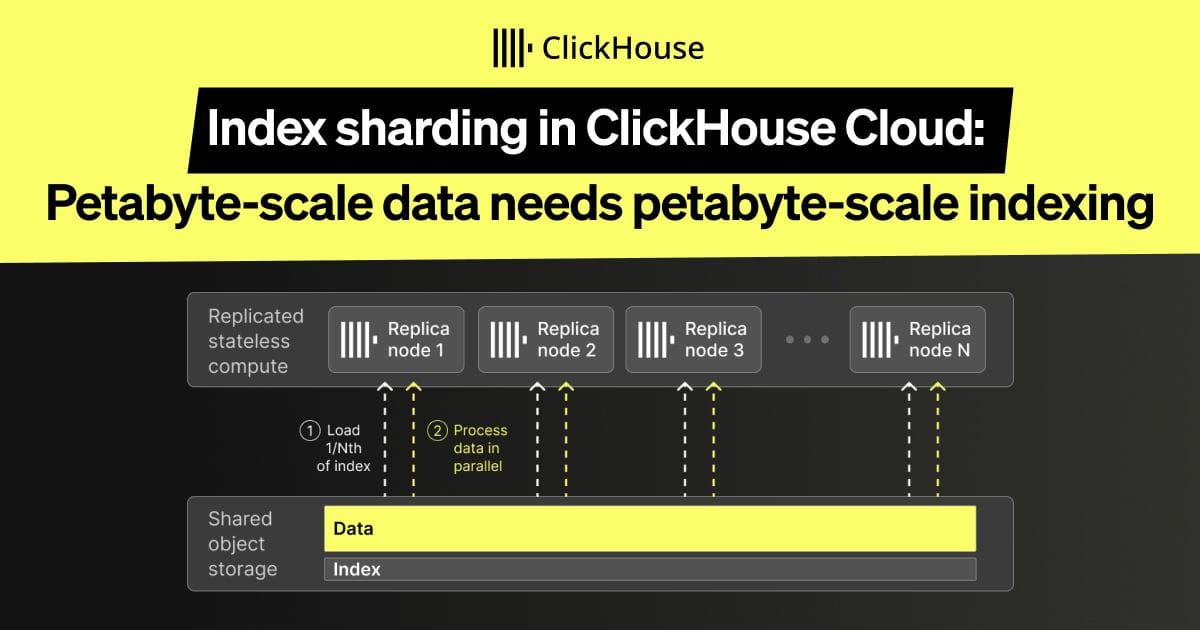
- Index sharding partitions indexes, with each replica responsible for a subset, managed via a virtual hash ring.
- Benefits include reduced memory per replica, horizontally scalable index analysis, and improved locality of reference.
- It significantly aids workloads with large tables and heavy secondary indexes (vector, full-text search, bloom filters).
- Failures in index analysis are handled by falling back to local analysis on the initiator replica.
- Scaling out with more replicas now directly contributes to faster index analysis, not just data read throughput.
📖 Source: Index sharding in ClickHouse Cloud: Petabyte-scale data needs petabyte-scale indexing
Related Articles
Comments (0)
No comments yet. Be the first to comment!