
ClickHouse AI Notebooks: Revolutionizing SRE Investigations

Alps Wang
Mar 19, 2026 · 1 views
AI as a Collaborator, Not a Replacement
ClickHouse's introduction of AI Observability Notebooks for Managed ClickStack marks a compelling evolution in how Site Reliability Engineers (SREs) approach system investigations. The emphasis on a structured, persistent notebook environment over a transient chat interface is a key differentiator. By embedding AI (specifically Anthropic's Claude models) as a collaborative partner within this notebook, engineers retain control while leveraging AI's power to explore logs, metrics, and traces. This approach directly addresses the iterative and often complex nature of production debugging, allowing engineers to ask natural language questions, inspect AI reasoning, and directly manipulate ClickHouse queries. The ability to branch investigations and maintain context across alternative lines of inquiry is particularly noteworthy, transforming a potentially chaotic incident response into a navigable, auditable workflow.
The technical integration is also a significant aspect. Instead of merely exposing raw SQL capabilities to an LLM, ClickHouse provides the AI with access to its internal investigative primitives and APIs. This allows the AI to orchestrate optimized queries, leverage precomputed views, and benefit from ClickHouse's inherent performance advantages. This 'opinionated' integration, where the AI acts as a smart orchestrator of existing tools rather than a free-form query generator, ensures both performance and transparency. The visibility of generated SQL and the ability for engineers to edit or override AI-generated steps underscore the commitment to human oversight and control. This design philosophy positions ClickHouse not just as a database but as a foundational data platform for AI-driven observability.
However, some limitations and concerns warrant consideration. While the private preview aims to refine the experience, the current 'last write wins' model for shared notebooks, while understandable during early stages, will need to evolve to support true concurrent editing for team collaboration. The reliance on Anthropic's Claude models means that the quality and biases of those specific models will directly influence the AI's effectiveness. Furthermore, the 'opinionated' nature of the integration, while beneficial for performance, might also limit the AI's flexibility in exploring entirely novel or unconventional investigative paths that fall outside the defined primitives. The success of this feature will heavily depend on the ongoing development of these internal APIs and the ability to expose them externally in the future, as hinted in the article, to foster a broader ecosystem. The gradual onboarding and focus on user feedback are positive signs, indicating a commitment to addressing these evolving needs.
Key Points
- ClickHouse is launching AI Observability Notebooks for Managed ClickStack in private preview.
- The feature embeds AI (Anthropic's Claude models) as a collaborator within a structured, persistent notebook environment for SRE workflows.
- Engineers can explore logs, metrics, and traces using natural language, inspect AI reasoning, and directly edit/run ClickHouse queries.
- The system offers branching capabilities for exploring alternative investigative paths without losing context.
- Integration is deep, with AI orchestrating ClickHouse's internal investigative primitives and APIs for optimized performance.
- The design emphasizes human oversight, transparency, and an iterative, collaborative workflow.
- Future plans include improved sharing, concurrent editing, exposing internal tools externally, and Slack integration.
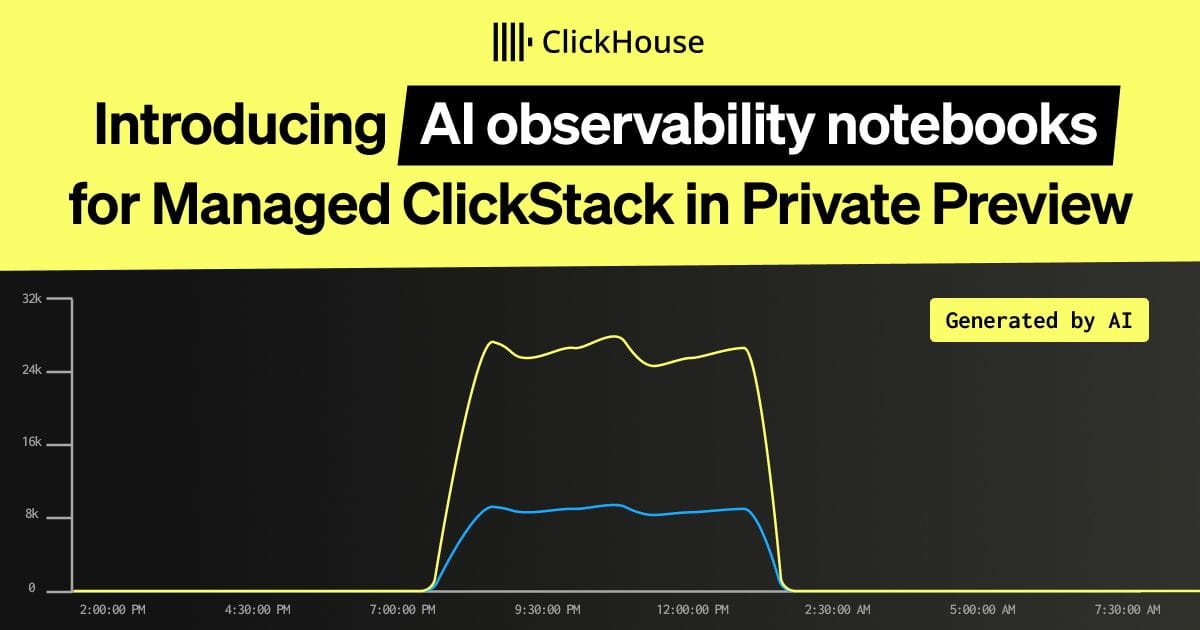
📖 Source: Introducing AI observability notebooks for Managed ClickStack in Private Preview
Related Articles
Comments (0)
No comments yet. Be the first to comment!