
Claude Opus 5.5: Smarter, Faster, Cheaper AI

Alps Wang
Sep 23, 2026 · 1 views
Opus 5.5: A Leap in Agentic AI
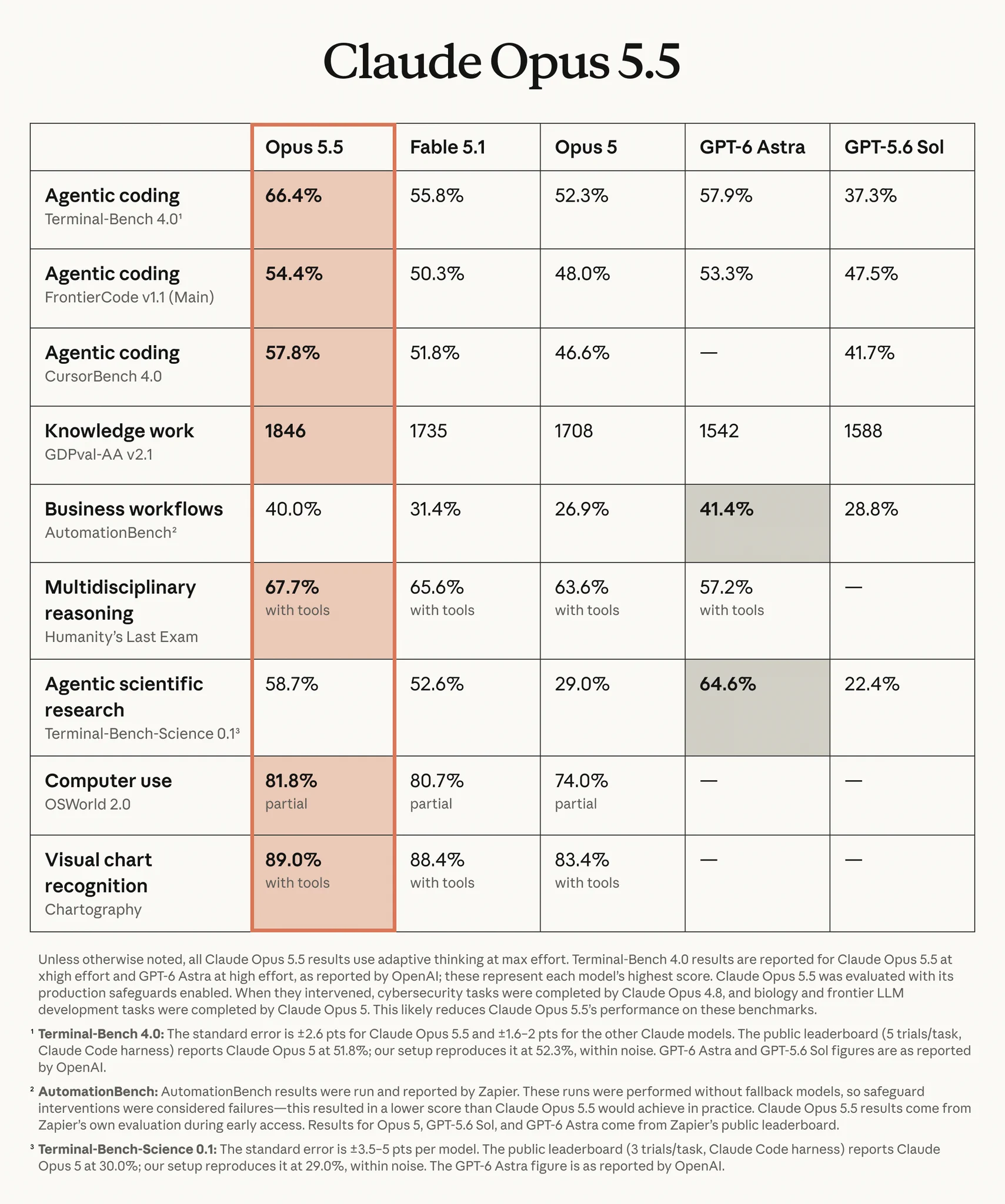
Anthropic's announcement of Claude Opus 5.5 presents a compelling narrative of advancement, particularly in agentic coding, computer use, and knowledge work. The claimed performance parity with Claude Fable 5.1, coupled with a 40% cost reduction and a 30% speed increase, positions Opus 5.5 as a highly attractive proposition for developers and businesses. The emphasis on improved natural communication and adherence to user instructions directly addresses common pain points in human-AI interaction, suggesting a more collaborative and efficient AI experience. The external validation by METR and Frontier Design, along with strong alignment test scores, adds significant credibility to these claims. The increased usage limits and rate limit resets for subscription users further enhance the value proposition, making it more accessible for intensive applications.
The core innovation lies in Anthropic's ability to seemingly achieve better performance and efficiency simultaneously, a feat that often involves difficult trade-offs. The claim of 'frontier results for a fraction of the cost' is particularly noteworthy. While the article doesn't delve into the specific architectural changes or training methodologies that enabled this leap, it strongly implies advancements in model architecture, inference optimization, or perhaps a more efficient training paradigm. The focus on agentic capabilities suggests a sophisticated understanding and execution of multi-step tasks, which is crucial for complex workflows in coding, data analysis, and research. The improvement in communication, making the AI 'less verbose' and more direct, is a subtle but critical enhancement for practical usability, especially in extended interaction sessions.
However, a key concern is the lack of granular technical details regarding the 'agentic coding' and 'computer use' capabilities. While the claims are bold, understanding the precise nature of these advancements—how Opus 5.5 interacts with external tools, its error handling in complex coding scenarios, or its ability to navigate and utilize digital environments—would provide greater clarity. The '40% less to run' metric is tied to 'default settings' and 'typical workloads,' which leaves room for interpretation and potential variability in real-world deployments. Users will need to conduct their own benchmarks to confirm these savings. Furthermore, while improved communication is a plus, the response to Prashant Mahajan's question about verbosity suggests that the model might still have tendencies that users wish to control, highlighting the ongoing challenge of balancing helpfulness with conciseness. The mention of 'alignment test' is positive but doesn't fully address potential biases or safety concerns that might arise from its enhanced capabilities, although Anthropic's historical focus on safety is a positive indicator.
Key Points
- Claude Opus 5.5 offers significant performance improvements over Opus 5, particularly in agentic coding, computer use, and knowledge work.
- It achieves performance levels comparable to Claude Fable 5.1 for most tasks.
- Costs are reduced by 40% compared to Opus 5.0 due to requiring less compute.
- Output generation is over 30% faster than Opus 5.
- Communication is more natural, with important information upfront and better adherence to writing rules.
- External evaluations by METR and Frontier Design confirm strong performance and alignment.
- Five-hour usage limits on Pro, Max, and Team plans are being increased, with subscription users receiving a rate limit reset.
- The model is positioned as a more effective collaborator due to these combined advances.
Related Articles
Comments (0)
No comments yet. Be the first to comment!