
chDB: The Agent's On-Demand Local Data Powerhouse

Alps Wang
Jul 8, 2026 · 1 views
Unlocking Agent Performance with Local Data
The article compellingly argues for chDB's role as a local data engine for AI agents, highlighting its ability to mitigate latency and instability issues inherent in network-bound data access. The core innovation lies in embedding a full ClickHouse query engine within the agent's process, enabling fast, deterministic data retrieval for memory, federation, and stability. The detailed explanation of how chDB handles structured data, time-series, and vector storage locally, coupled with its robust data format support for federation, presents a powerful solution for complex agent workflows. The argument for stability and token optimization is particularly strong, as it directly addresses the economic and performance impact of network failures and retries in LLM-based agents. The real-world data cited further solidifies the claims, making a strong case for its adoption.
However, while the benefits are clear, the article could delve deeper into the practical aspects of integrating chDB into existing agent frameworks. Scalability considerations for highly distributed agent systems, beyond the mention of AWS Lambda MicroVMs, could be elaborated. The management of local state, especially in scenarios with frequent agent restarts or migrations, might present challenges not fully explored. Furthermore, while chDB's ability to query various data sources locally is a key feature, the article could benefit from more concrete examples of complex federated queries that showcase its full potential. The security implications of local data storage within agent processes, particularly in multi-tenant environments, might also warrant further discussion. Despite these points, the article successfully positions chDB as a vital component for building performant and cost-effective AI agents.
Key Points
- chDB embeds a full ClickHouse query engine locally within an AI agent's process to reduce network latency and instability.
- It serves as local agent memory, supporting structured data, time-series, and vector search for efficient recall and decision-making.
- chDB acts as a data federation hub, allowing single SQL queries to join local files, remote databases, and in-process DataFrames.
- Localizing data access dramatically improves stability, preventing costly token retries and detours in LLM agent loops.
- The architecture is particularly well-suited for serverless environments like AWS Lambda MicroVMs, offering state persistence and near-instant resumes.
- It leverages ClickHouse's columnar and append-only nature for efficient archival and audit trails, similar to observability data.
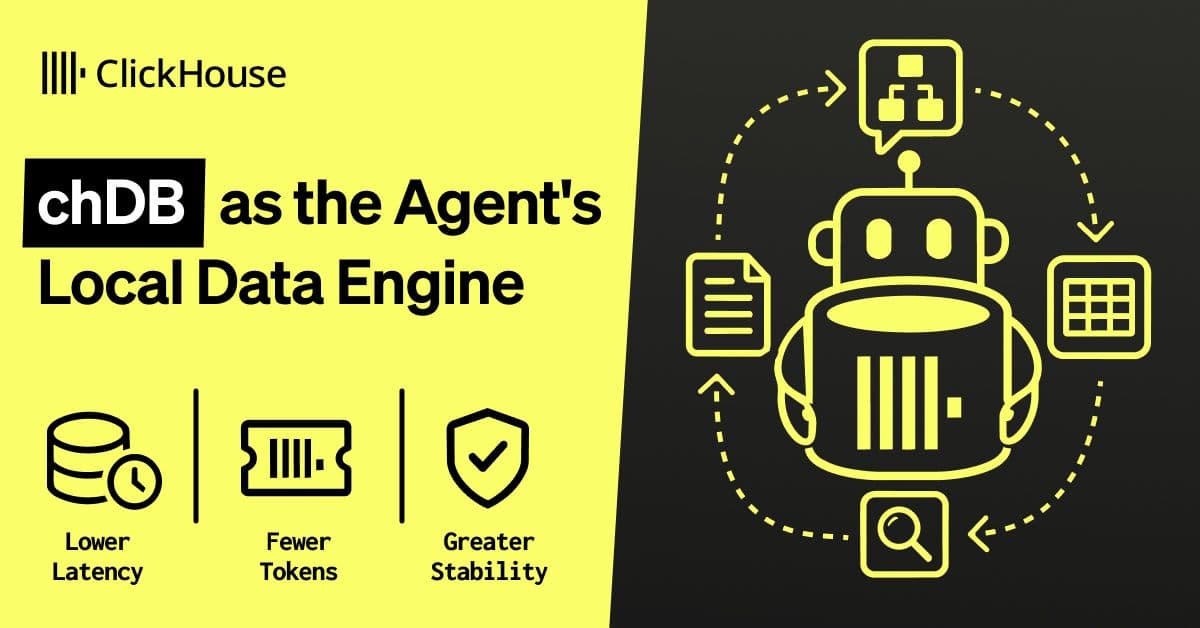
📖 Source: chDB as the Agent's Local Data Engine
Related Articles
Comments (0)
No comments yet. Be the first to comment!