
Chaos Engineering for Massive GPU Clusters Unveiled

Alps Wang
Jul 11, 2026 · 1 views
Navigating GPU Cluster Complexity
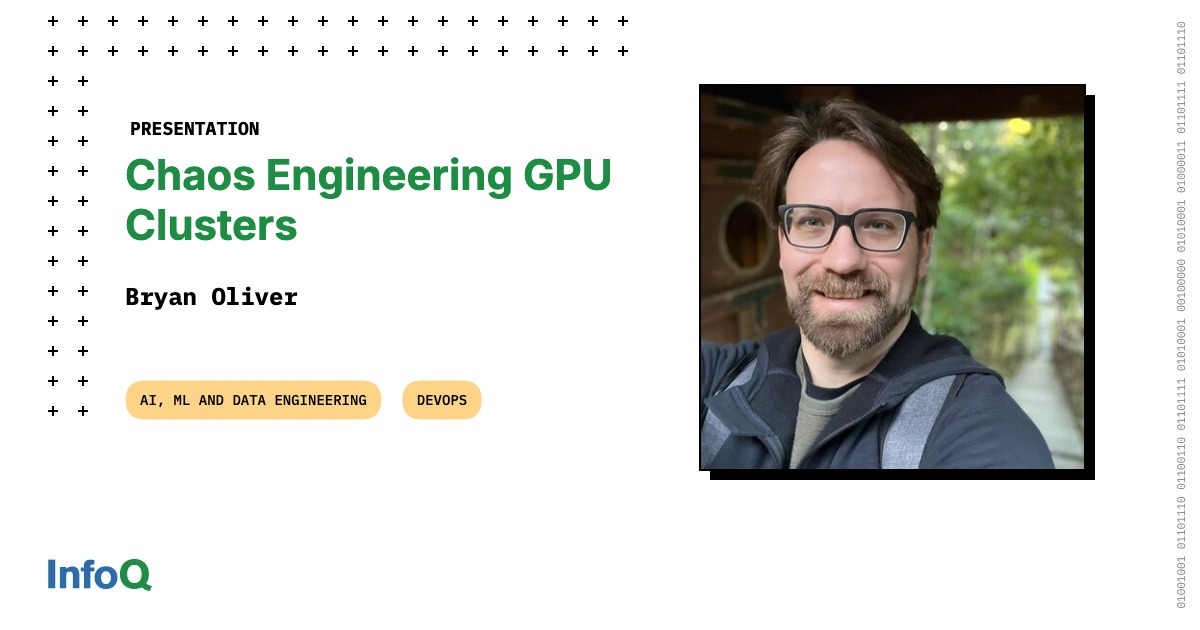
Bryan Oliver's presentation delves into the complex world of chaos engineering for large-scale GPU clusters, a crucial but often overlooked aspect of modern AI infrastructure. The core insight is the necessity of proactively identifying and mitigating failures in these highly distributed and interconnected systems, especially given their multi-million dollar cost and the immense performance demands of AI workloads. The discussion around RDMA, NVLink, and InfiniBand highlights the intricate networking that underpins these clusters, and how failures in these high-speed interconnects can cascade, impacting performance and reliability. The practical fault-injection strategies and the emphasis on building robust observability loops are particularly valuable for engineering leaders tasked with ensuring the uptime and efficiency of these critical resources.
One of the most noteworthy aspects is the stark contrast drawn between traditional CPU clusters and modern GPU clusters, particularly in terms of scale, interconnect speeds, and the inherent unreliability of large-scale hardware. The presentation effectively communicates the challenge of topology-aware scheduling, where the physical proximity of GPUs directly impacts communication speeds, making failures in certain network segments or nodes more impactful. The mention of NUMA misalignments as a source of complexity further underscores the sophisticated engineering required. However, a potential limitation for a broader audience might be the deep dive into low-level networking libraries like libibverbs and UCX, which, while essential for true observability, could be overwhelming for those less familiar with high-performance networking.
The presentation is highly beneficial for platform engineers, SREs, and AI infrastructure architects who are responsible for building, managing, and ensuring the reliability of large-scale GPU deployments. It provides a roadmap for approaching the inherent instability of these complex systems by embracing chaos engineering. The insights into fault injection techniques and observability can significantly improve hardware utilization, reduce downtime, and ultimately lower the operational cost of AI infrastructure. The comparison to older cluster management systems like Slurm implicitly suggests that Kubernetes, with its focus on resilience and observability, is a more suitable platform for the future of AI workloads, especially when combined with these advanced chaos engineering practices.
Key Points
- Chaos engineering is essential for ensuring the reliability and efficiency of large-scale GPU clusters used for AI.
- Modern GPU clusters are vastly more complex than traditional CPU clusters due to high-speed interconnects like RDMA, InfiniBand, and NVLink.
- Failures in GPU-to-GPU networking and hardware can have significant cascading effects on AI workload performance.
- Topology-aware scheduling is critical, as GPU proximity directly impacts communication speeds and performance.
- Practical fault injection strategies and robust observability loops are key to managing GPU cluster complexity and maximizing hardware efficiency.
- Kubernetes is emerging as a preferred platform for AI workloads due to its resilience and observability features, complementing advanced chaos engineering practices.
Related Articles
Comments (0)
No comments yet. Be the first to comment!