
Brownfield Code: Mob Programming Beats AI Vibes

Alps Wang
Aug 25, 2026 · 1 views
Humanity's Edge in AI's Shadow
The InfoQ podcast 'The Human Edge: Why Brownfield Codebases Need Mob Programming, Not Just AI Vibes' presents a compelling argument for the continued relevance and superiority of human-driven collaborative practices, particularly mob programming, in complex 'brownfield' software development environments, even in the face of advancing AI. The core insight is that while AI excels at specific analytical tasks and code generation for well-defined problems, it fundamentally lacks the tacit knowledge and contextual understanding essential for navigating the intricacies of legacy systems. The podcast effectively highlights how AI, while useful for tasks like telemetry visualization or kickstarting development, falls short when it comes to owning and evolving domain logic in these complex scenarios, leading to potentially 'subpar' code. The emphasis on 'code that is easy to change' as the ultimate goal, rather than just 'good code', is a powerful reframing that naturally leads to adopting robust design principles like high cohesion and low coupling. This focus on maintainability and adaptability is precisely where human expertise, amplified by collaborative techniques, shines.
The innovative aspect lies in its direct challenge to the prevailing narrative that AI is on the cusp of replacing human developers, especially in challenging real-world scenarios. The podcast advocates for a symbiotic relationship where AI augments human capabilities rather than supplanting them, particularly in the context of brownfield code. The concept of extending mob and pair programming to all team tasks, including documentation and analysis, is a key takeaway, emphasizing the creation of psychological safety and the elimination of knowledge silos. This approach fosters a continuous learning environment where new team members can become productive immediately. The 'no outside pull requests' policy, forcing genuine pair programming for external changes, reinforces team ownership and system coherence, directly addressing the integration challenges often found in legacy systems. The podcast's strength lies in its practical, experience-driven perspective from developers working at SpareBank 1 Utvikling, a large financial institution with high stakes, demonstrating that these practices are not just theoretical ideals but proven methods for high-quality, high-velocity delivery.
However, a potential limitation could be the lack of deeper technical exploration into why AI struggles with tacit context. While the podcast states it as a fact, a more detailed explanation of the underlying AI limitations (e.g., model architecture, training data biases, inability to truly 'understand' system history) could further solidify the argument. Additionally, while the benefits of mob programming are clearly articulated, the scalability and potential overhead for very large, distributed teams might warrant further discussion. Nevertheless, for development teams grappling with legacy systems, or those seeking to build more resilient and adaptable software, this podcast offers invaluable guidance, reinforcing the enduring power of human collaboration and strategic AI integration.
Key Points
- AI excels at analysis, telemetry visualization, and task kickstarting but lacks tacit context for complex brownfield code.
- Mob and pair programming, extended to all team tasks, are foundational for high-quality, high-velocity delivery by spreading domain knowledge and eliminating silos.
- Constant mob programming fosters psychological safety, enabling new team members to contribute from day one.
- A strict 'no outside pull requests' policy enforces genuine collaboration and team ownership.
- The goal of 'code that is easy to change' naturally leads to adopting design principles like high cohesion and low coupling.
- Human developers remain the owners of domain logic in complex environments to avoid subpar code.
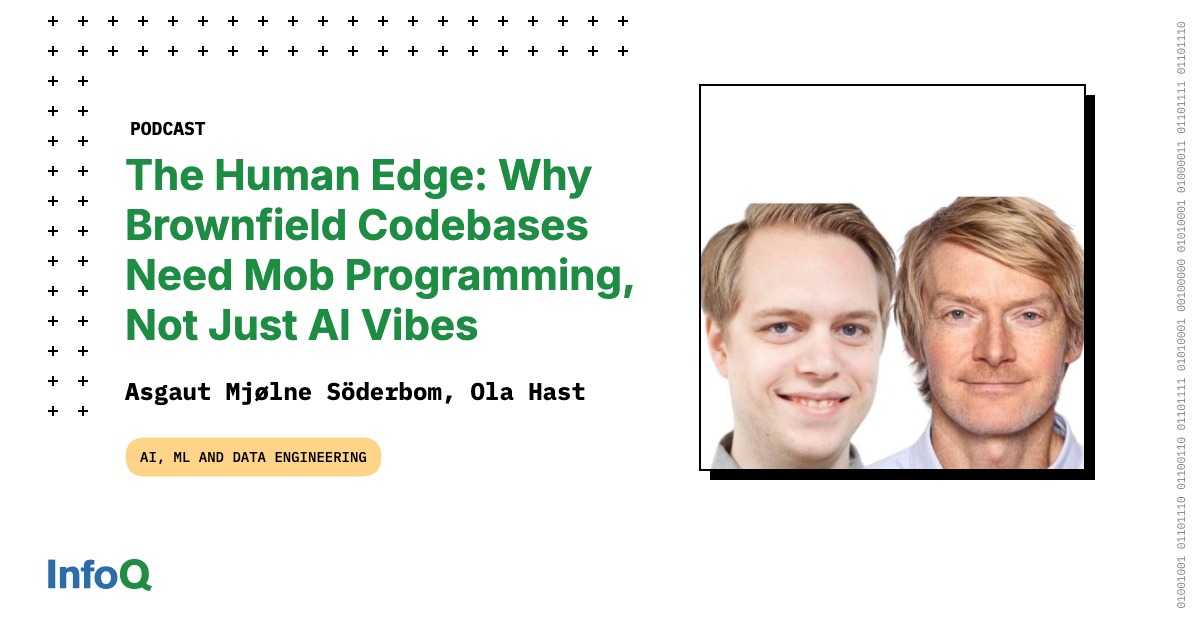
📖 Source: Podcast: The Human Edge: Why Brownfield Codebases Need Mob Programming, Not Just AI Vibes
Related Articles
Comments (0)
No comments yet. Be the first to comment!