
AWS Unlocks S3 with File System Access

Alps Wang
Apr 17, 2026 · 1 views
Bridging Object Storage and File Systems
AWS S3 Files represents a compelling evolution in cloud storage, effectively democratizing access to object storage for applications traditionally reliant on file system interfaces. The ability to mount S3 buckets and interact with data via standard file operations significantly lowers the barrier to entry for many workloads, particularly in areas like AI/ML, analytics, and media processing. The underlying architecture leveraging Amazon EFS for high-performance caching and low-latency access, while abstracting away the complexities of object storage for the end-user, is a clever engineering feat. The intelligent prefetching and automatic eviction of inactive data further enhance its appeal by optimizing for both performance and cost. This move directly addresses a common pain point for developers, offering a more intuitive and familiar way to work with vast datasets stored in S3.
However, the announcement is not without its nuances and potential concerns. The reliance on EFS infrastructure, while providing performance benefits, also brings EFS's pricing model into play, which can be perceived as 'eye-watering' for some use cases, especially for smaller, more frequent accesses. While AWS suggests that overall costs might remain lower due to only active data residing on the file system, this needs careful cost management and testing by users. The initial limitations, such as mandatory S3 versioning, lack of IaC support at launch, and a less-than-obvious IAM setup, are also points to consider for immediate adoption. The humorous reactions from the community about S3 'not being a filesystem' highlight the historical context and the significant shift this represents. The conflict resolution mechanism, where S3 is the source of truth and filesystem versions go to 'lost+found,' is a standard approach but requires developer awareness. Ultimately, S3 Files is a powerful tool, but its success will hinge on clear communication of its cost structure and continued development to address initial limitations.
Key Points
- AWS S3 Files allows S3 buckets to be mounted and accessed as a standard file system.
- Applications can use familiar file operations (read/write) that translate to S3 requests.
- Leverages Amazon EFS for high-performance storage of active data with ~1ms latencies.
- Automatically serves less frequently accessed files directly from S3 for throughput.
- Supports concurrent access from multiple compute resources with NFS close-to-open consistency.
- Intelligent prefetching anticipates data access needs.
- Changes are committed back to S3 approximately every 60 seconds as a single PUT.
- S3 is the source of truth in case of conflicts, with filesystem versions moved to 'lost+found'.
- File data inactive for 30 days is evicted from the filesystem but not deleted from S3.
- Potential cost concerns due to EFS pricing model, though active data costs may be lower.
- Initial limitations include mandatory S3 versioning and lack of IaC support at launch.
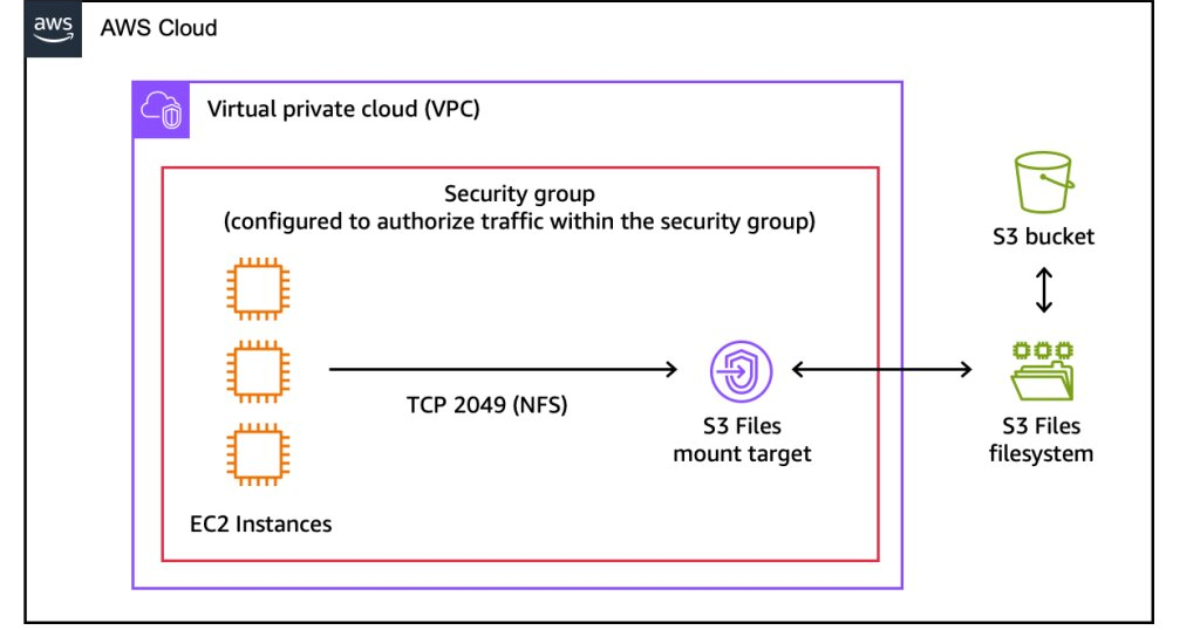
📖 Source: AWS Introduces S3 Files, Bringing File System Access to S3 Buckets
Related Articles
Comments (0)
No comments yet. Be the first to comment!