
AWS AI Powers Safer Workplaces

Alps Wang
Apr 2, 2026 · 1 views
Automating Safety with AI
The AWS Architecture Blog post details a sophisticated solution for automating workplace safety monitoring using computer vision and generative AI. The architecture is commendable for its serverless, event-driven design, emphasizing scalability and cost-efficiency. The use of multiple AWS accounts for segregation of concerns (training, inference, analytics) is a strong security and operational practice. The dual-detection annotation method, capturing both object outlines and floor projections, along with generative AI for synthetic data (GLIGEN) to overcome data scarcity and improve tape labeling, are particularly innovative. The phased approach to risk detection, starting only after Zone Owner configuration, and the hierarchical role-based access control structure demonstrate a well-thought-out implementation that balances automation with human oversight and data privacy.
However, while the article highlights anonymization of faces, deeper discussion on other PII concerns beyond facial blurring, such as gait analysis or unique identifiers in clothing, would strengthen its privacy claims. The reliance on a fixed camera network, while practical for many environments, might not be suitable for dynamic or rapidly changing operational areas. Furthermore, the article could benefit from more explicit discussion on the potential for 'alert fatigue' beyond aggregation, perhaps exploring intelligent prioritization of alerts based on severity and real-time contextual data. The 'Intelligent Alarm Detection' and risk management sections, while promising, could be expanded to detail the specific algorithms or heuristics used for validating and escalating findings, offering more insight into the system's 'intelligence'. The integration of generative AI for synthetic data, while promising, is still a nascent field, and the practical challenges and limitations of generating truly representative synthetic data for complex safety scenarios warrant further exploration.
This solution is highly beneficial for organizations with large, distributed facilities where manual safety monitoring is impractical and costly. This includes manufacturing plants, distribution centers, construction sites, and even large office complexes with hazardous areas. Companies aiming to improve OSHA compliance, reduce workplace injuries and associated costs, and foster a stronger safety culture will find this architecture compelling. The detailed breakdown of the ML pipeline, from data collection and anonymization to training, model promotion, and inference, provides a valuable blueprint for organizations looking to implement similar AI-driven solutions. Its extensibility across different industries, as stated in the article, is a key strength, suggesting a versatile platform for diverse safety challenges.
Key Points
- The solution leverages a serverless, event-driven architecture on AWS for scalable, real-time safety monitoring.
- It uses computer vision for hazard detection (PPE compliance, zone violations) and generative AI for synthetic data generation (e.g., tape labeling).
- Key architectural decisions include multi-account segregation for security and operational efficiency.
- Privacy is addressed through face anonymization and blurring.
- A hierarchical role-based access control system manages user permissions and workflows.
- The system focuses on continuous monitoring, risk aggregation to prevent alert fatigue, and automated closing of resolved risks.
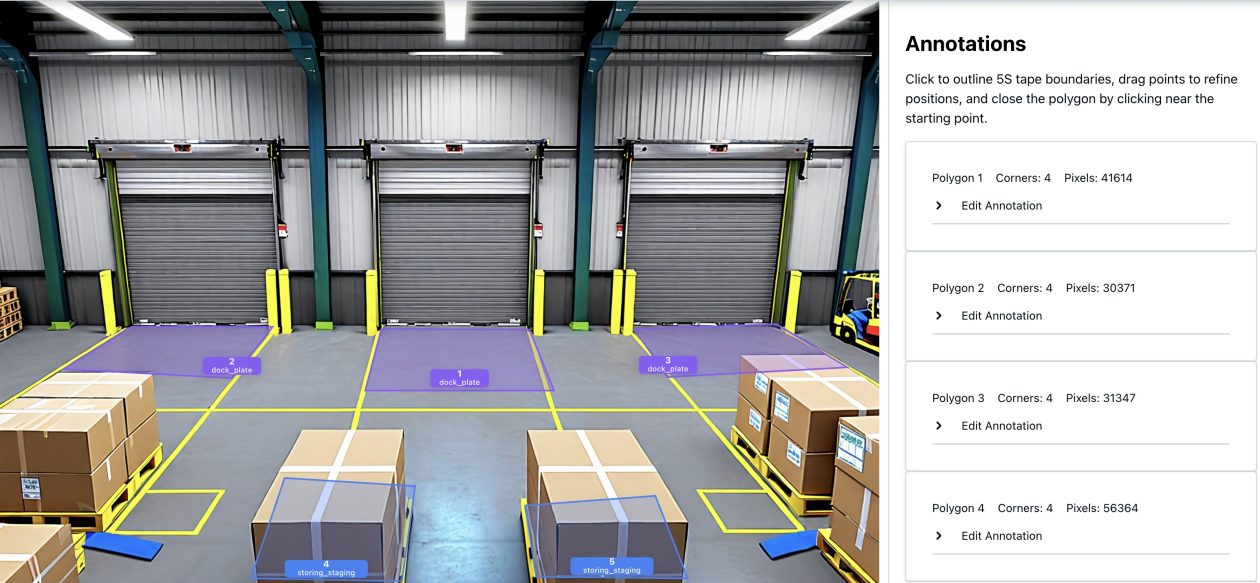
- Innovative tape labeling preparation uses image stitching from multiple frames to create unobstructed views of floor markings.
- The architecture is designed for broad applicability across various industries beyond distribution centers.
📖 Source: Automate safety monitoring with computer vision and generative AI
Related Articles
Comments (0)
No comments yet. Be the first to comment!