
Autonomous Data: GenAI's New Infrastructure

Alps Wang
Jul 25, 2026 · 1 views
Taming the Data Hairball for AI
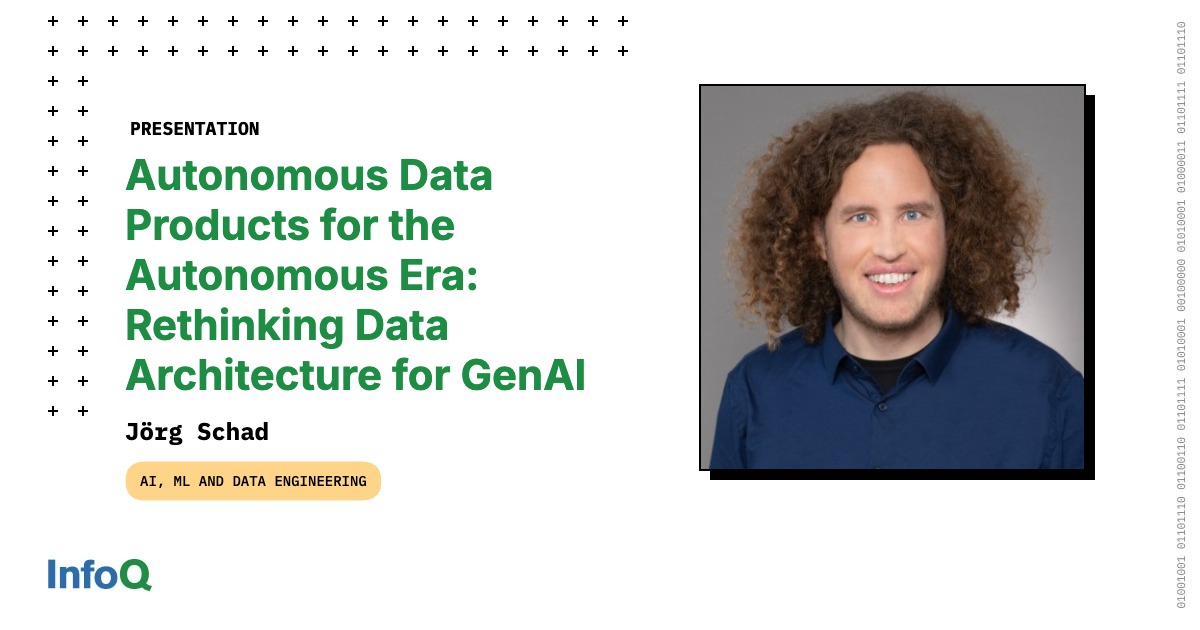
Jörg Schad's presentation on 'Autonomous Data Products for the Autonomous Era' eloquently articulates a pressing problem: the 'data management hairball' hindering the effective deployment of GenAI. The core insight lies in reframing data architecture through the lens of autonomous agents, moving beyond human-centric data access. The proposed solution, 'autonomous data products,' acting as encapsulated units of data, pipelines, schemas, and metadata, draws a compelling parallel to containerization in microservices. This approach promises standardization, encapsulation, and discoverability, addressing key challenges like context rot, speed of access, specificity, and safety. The emphasis on protocols like MCP for progressive tool discovery and limiting context exposure is particularly noteworthy, aiming to prevent LLMs from being overwhelmed by irrelevant information, thus mitigating hallucinations and improving performance. This is a significant step towards operationalizing GenAI at scale.
However, the presentation, while insightful, could benefit from deeper dives into the practical implementation challenges of these autonomous data products. While the analogy to Docker and Kubernetes is strong, the concrete mechanisms for building, deploying, and managing these 'data containers' in a decentralized manner (implied by the mention of Data Mesh) require further elaboration. The 'progressive tool discovery via protocols like MCP' is a promising concept, but its real-world adoption and interoperability across diverse data sources and AI frameworks remain a key question. Furthermore, the 'safety aspect,' while highlighted as critical, needs more tangible examples of how governance policies are enforced within these autonomous products to prevent data leakage or unauthorized access, especially when dealing with sensitive enterprise data. The presentation lays a strong theoretical foundation, but bridging the gap to practical, enterprise-ready implementation will be crucial for its widespread adoption.
Key Points
- The primary failure mode for GenAI projects is underestimating the operational and data access complexities, not model performance.
- Current data architectures are a "data management hairball" due to fragmentation across organizational roles and tools.
- Autonomous agents require a new data architecture paradigm, moving beyond human-centric access.
- "Autonomous data products" are proposed as encapsulated units containing data, pipelines, schemas, and metadata, analogous to containers in microservices.
- Key problems addressed include standardization, speed of access, specificity (context rot), and safety.
- Progressive tool discovery via protocols like MCP limits context exposure, mitigating LLM performance degradation and hallucinations.
- The presentation draws parallels with Docker and Kubernetes, advocating for standardization and orchestration in the data domain.
- The "Data 2.0 Problem" stems from organizational silos and architectural complexity, leading to slow development cycles.
- Context rot occurs when LLMs are overloaded with too much information, leading to performance issues and hallucinations.
- Safety in autonomous data access is paramount, requiring enforcement of data quality and privacy rules.
Related Articles
Comments (0)
No comments yet. Be the first to comment!