
AI's Rise: Reshaping Developer Training

Alps Wang
Sep 14, 2026 · 1 views
The Human Element in AI Development
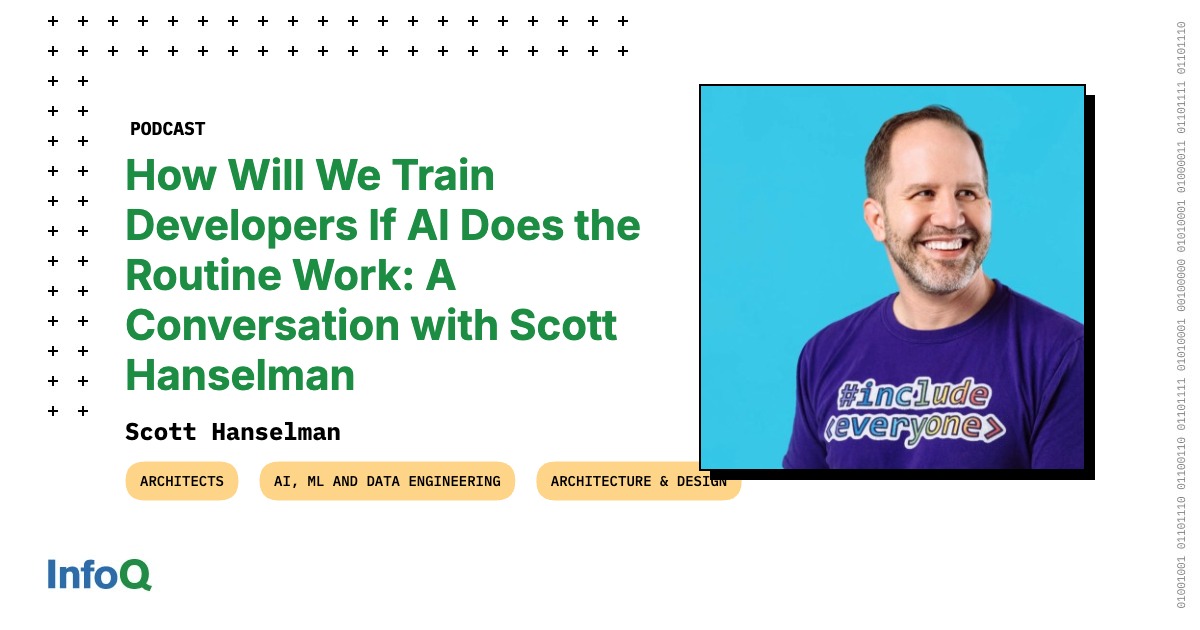
Scott Hanselman's discussion with Michael Stiefel on InfoQ presents a timely and insightful perspective on the profound impact of AI on software development, particularly concerning the training of new engineers. The core argument for adopting a preceptorship model, inspired by nursing, is compelling. By shifting the evaluation metric from code shipped to engineers developed, the industry can foster a more sustainable pipeline of talent. This approach acknowledges that while AI excels at generating code snippets and features, it fundamentally lacks the contextual understanding and architectural foresight of experienced human engineers. Therefore, the role of senior developers must evolve from individual contributors to dedicated mentors, ensuring that human judgment remains central and that AI tools are leveraged effectively rather than becoming a crutch that stunts growth.
A significant concern raised is the potential for AI to automate away the foundational, albeit sometimes tedious, tasks that have historically served as entry points for junior developers. If these 'wax on, wax off' moments are bypassed, new engineers may miss crucial learning opportunities, leading to a deficit in fundamental understanding and problem-solving skills. Furthermore, Hanselman astutely identifies the growing isolation among developers, exacerbated by the confluence of remote work, social media, and AI. This isolation impedes crucial social and professional development, highlighting the necessity of intentional human connection and in-person interaction for nurturing well-rounded engineers. The call for businesses to prioritize long-term investment in human capital over short-term hyper-optimization is a critical wake-up call, suggesting that neglecting mentorship now will lead to a severe talent shortage in the future. The implications for universities are also significant, suggesting a need to integrate AI literacy and ethics into curricula to ensure graduates are prepared for this new paradigm without becoming overly reliant on AI.
Key Points
- The software industry needs to adopt a preceptorship model for training new engineers, similar to nursing, where trainers are evaluated on their ability to develop engineers, not ship code.
- AI agents are capable of generating software features but perform poorly in software architecture due to a lack of contextual understanding and big-picture perspective.
- Experienced engineers must maintain oversight of AI tools, acting as reviewers and coordinators to ensure human judgment remains central to the development process.
- Businesses must prioritize long-term investments in human capital and mentorship over short-term hyper-optimization to sustain the pipeline of future senior talent.
- Remote work, social media, and AI contribute to developer isolation, making intentional human connection and in-person interactions vital for healthy professional growth.
- Universities need to adapt their curricula to include AI ethics and responsible AI usage, ensuring graduates don't become overly reliant on AI and their cognitive skills atrophy.
Related Articles
Comments (0)
No comments yet. Be the first to comment!