
Airbnb's Sitar-Agent: Kubernetes Config at Scale

Alps Wang
Jul 9, 2026 · 1 views
Kubernetes Configuration Reimagined
Airbnb's detailed breakdown of the Sitar-agent's evolution offers a compelling case study in modernizing a crucial piece of infrastructure. The shift from Sparkey to SQLite, the introduction of snapshot bootstrapping from S3, and the explicit decision to favor a sidecar over in-application libraries all highlight a pragmatic approach to achieving reliability, performance, and operational simplicity at immense scale. The language independence provided by the sidecar pattern is a particularly strong point, directly addressing a common challenge in polyglot microservice environments. The emphasis on reducing dependency on centralized configuration infrastructure is also a noteworthy trend, pointing towards more resilient and distributed system designs.
However, the article could benefit from a deeper dive into the trade-offs inherent in this architecture. While the sidecar simplifies operations and ensures consistency, it inherently increases resource consumption per pod. The article mentions this as a potential downside of the sidecar approach compared to libraries, but doesn't quantify the impact or discuss mitigation strategies beyond the S3 snapshot bootstrapping. Furthermore, while SQLite is praised for its simplicity and concurrency, its suitability for extremely high-volume, low-latency read operations across tens of thousands of pods, especially under heavy load, might warrant further scrutiny. The 'tens of seconds' propagation time, while an improvement, could still be a bottleneck for certain real-time configuration changes. Future iterations might explore more active pushing mechanisms or specialized local caching solutions to further reduce latency.
Key Points
- Airbnb developed Sitar-agent, a Kubernetes sidecar for dynamic configuration distribution across tens of thousands of pods.
- The system enables configuration changes to propagate within tens of seconds while maintaining availability during disruptions.
- Key architectural improvements include a Java rewrite, S3 snapshot bootstrapping, and migration from Sparkey to SQLite.
- The sidecar approach provides language independence and centralizes configuration delivery logic.
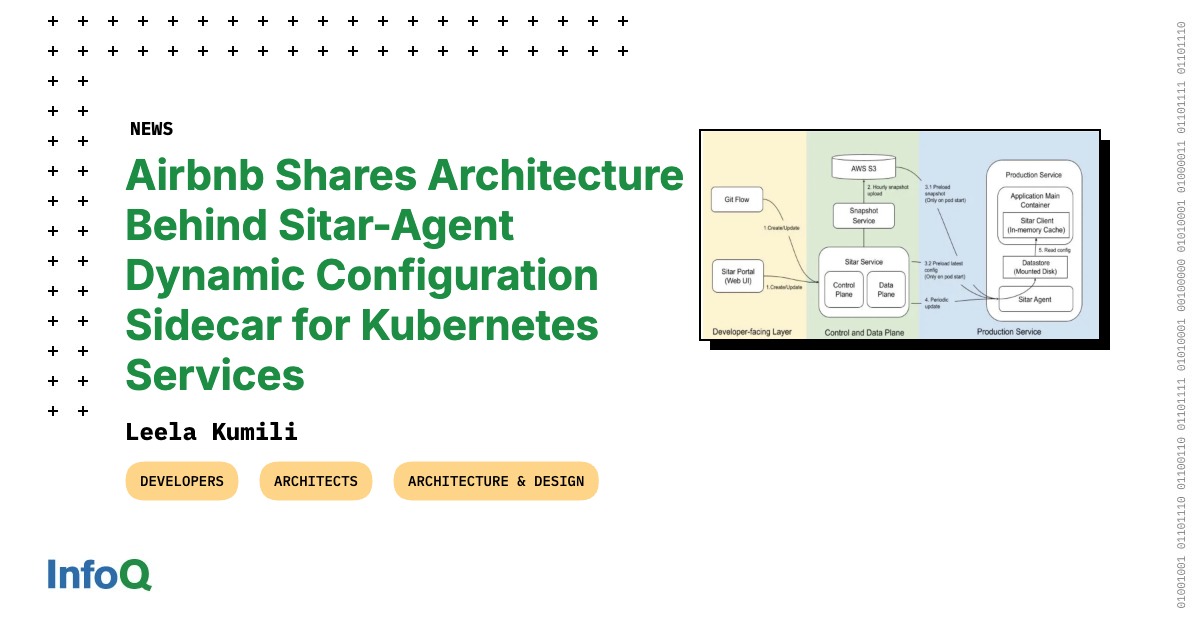
- Snapshot bootstrapping reduces startup overhead and allows services to operate during central configuration service unavailability.
- SQLite was chosen over RocksDB for its concurrency model, operational simplicity, and broad language support.
- A pull-based model with Sitar-agent polling the backend every ten seconds is used, optimized with server-side caching and incremental change tracking.
📖 Source: Airbnb Shares Architecture Behind Sitar-Agent Dynamic Configuration Sidecar for Kubernetes Services
Related Articles
Comments (0)
No comments yet. Be the first to comment!