
AI Reliability: Beyond Vibes to Robust Frameworks

Alps Wang
May 27, 2026 · 1 views
Engineering Trust in AI Systems
Aaron Erickson's presentation offers a pragmatic and experience-driven perspective on building reliable AI platforms, moving beyond the initial hype of 'AI for everything.' The core message of combining deterministic guardrails with agentic discovery is a critical insight for anyone deploying AI in production. His journey from a reorg software company to NVIDIA, and the subsequent lessons learned from the 'Llo11yPop' project, highlight the evolution of thinking about AI system design. The emphasis on structured agent hierarchies, off-ramps to determinism, and the analogy of simpler menus for LLMs are particularly noteworthy. These are not just theoretical concepts but practical strategies derived from real-world challenges in managing complex computational resources. The discussion around 'rare context' and semantic layers is also highly relevant, as it directly addresses a fundamental limitation of current LLMs in understanding specialized domains without explicit guidance.
However, the presentation, while rich in practical advice, could benefit from a more detailed exploration of the 'how' behind certain concepts. For instance, the specifics of implementing 'purpose-built agent hierarchies' and how to effectively map these to organizational structures would be valuable. The 'evaluation pyramids' are mentioned as a way to ensure architecture scales effectively, but the details of constructing and utilizing these pyramids remain somewhat abstract. Furthermore, while the talk touches upon the limitations of LLMs in coding and joins, a deeper dive into the metrics used to quantify the '70% right to up in the upper 90s' accuracy improvement would strengthen the technical credibility. The audience might also appreciate more concrete examples of how time-series foundation models are leveraged for anomaly detection in practice, beyond the mention of their application at NVIDIA.
Despite these minor areas for deeper exploration, the presentation provides a strong foundation for understanding the engineering discipline required to build dependable AI systems. It's a valuable resource for ML engineers, data scientists, and software architects who are tasked with moving AI from experimental stages to production-ready applications. The insights are directly applicable to anyone managing complex data pipelines, resource allocation, or building multi-agent systems. The comparison to traditional software engineering practices, like the test pyramid, helps ground the AI-specific challenges within a familiar framework, making the concepts more accessible and actionable. The talk effectively bridges the gap between the aspirational capabilities of AI and the practical realities of building robust, scalable, and reliable systems.
Key Points
- AI platform development is evolving from subjective 'vibe checking' to structured, multi-agent frameworks.
- Combining deterministic software guardrails with agentic discovery is crucial for reliability.
- Optimizing agent hierarchies, analogous to organizational structures (VP, Manager, IC), improves system efficiency and focus.
- 'Off-ramps to determinism' are essential for enhancing reliability by simplifying tasks for LLMs.
- LLMs benefit from constrained problem spaces; simpler queries and limited tool options improve accuracy.
- Addressing 'rare context' and building semantic layers are vital for LLMs to understand specialized domains.
- Rigorous evaluation pyramids are necessary for scaling AI architectures effectively in production.
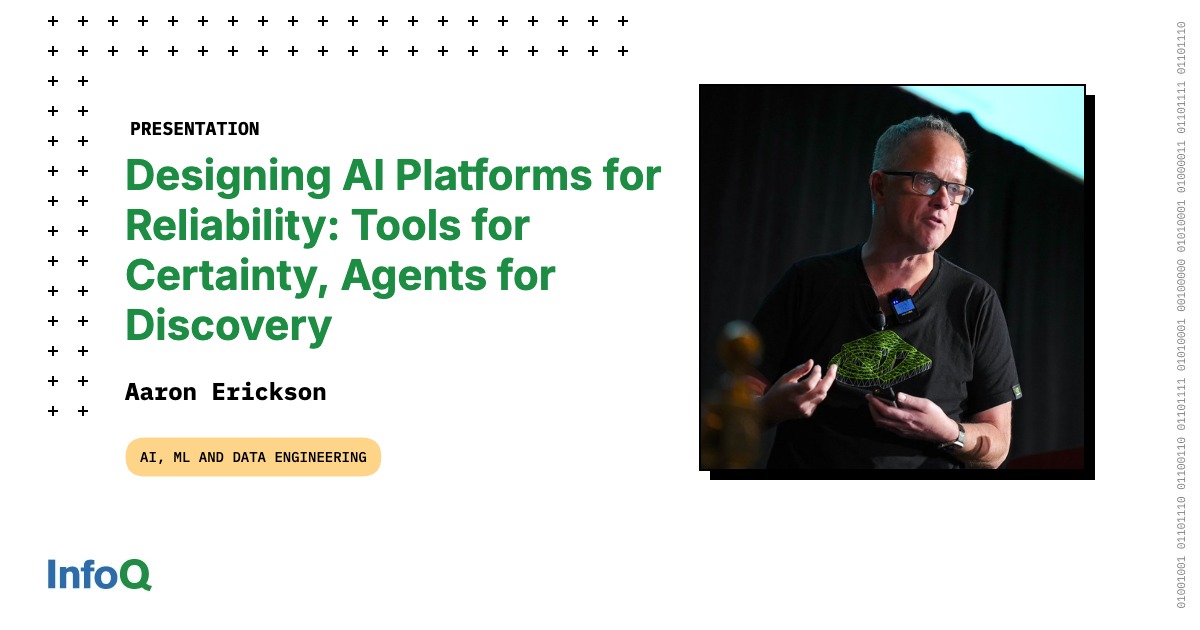
📖 Source: Presentation: Designing AI Platforms for Reliability: Tools for Certainty, Agents for Discovery
Related Articles
Comments (0)
No comments yet. Be the first to comment!