
AI-Powered SDLC: Lessons from Claude Code

Alps Wang
May 8, 2026 · 1 views
The Agentic Acceleration Shift
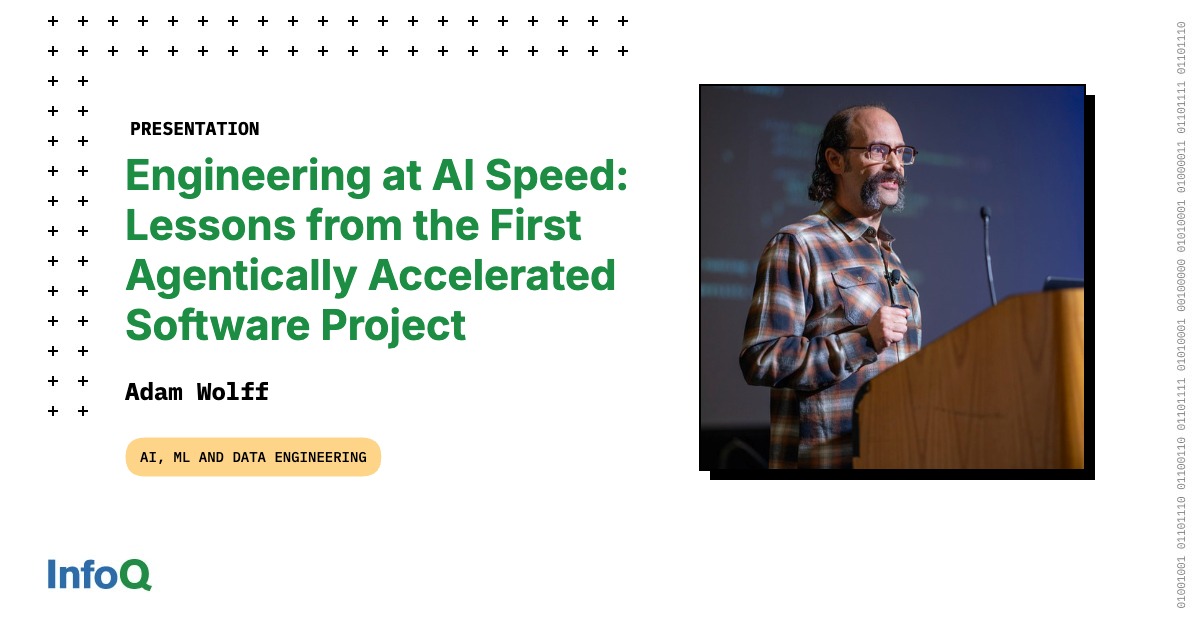
Adam Wolff's presentation on 'Engineering at AI Speed' provides a compelling case study on how agentic AI tools like Claude Code are fundamentally altering the software development lifecycle (SDLC). The core insight is the shift of bottlenecks from implementation to architectural decision-making, emphasizing that with AI drastically reducing coding costs, the speed of learning and iteration becomes the paramount competitive advantage. The 'dogfooding' strategy and the emphasis on rapid unshipping are crucial takeaways, demonstrating that real-world feedback, even from shipping imperfect products quickly, is vital for refining complex systems. The 'war stories' effectively illustrate the unpredictable nature of software development, even with AI assistance, particularly when dealing with nuanced challenges like Unicode handling in input systems or the complexities of shell integration.
While the presentation highlights the power of AI in accelerating development and enabling ambitious re-implementations (like the cursor class), it also implicitly underscores the enduring complexity of software engineering. The challenges encountered with Unicode, grapheme clustering, and normalization, despite AI's assistance, show that understanding fundamental computer science principles remains critical. The trade-offs between eager and lazy computation, and the need for optimization passes, are timeless engineering concerns that AI augments rather than replaces. The concern for readers might be the potential for increased system complexity and the risk of over-reliance on AI, which could lead to subtle bugs or performance regressions if not managed with rigorous testing and architectural foresight. The presentation could benefit from a more in-depth discussion on the architectural patterns that best support agentic acceleration, beyond the cursor and shell examples, especially concerning state management and data persistence in highly iterative AI-driven development workflows, which are areas of growing interest for database professionals.
Key Points
- The primary bottleneck in software development is shifting from implementation to architectural decision-making due to AI.
- When coding costs approach zero, the speed of learning and iteration becomes the sole competitive advantage.
- "Dogfooding" and rapid unshipping are vital for understanding real-world requirements and refining complex systems.
- AI accelerates development but does not eliminate inherent software engineering complexity, particularly in areas like Unicode handling.
- Architectural choices, such as a testable, immutable cursor class, significantly impact the ability to iterate and add features like Vim mode.
- Challenges in input handling, like Unicode grapheme clustering and normalization, highlight the need for deep understanding of underlying standards, even with AI assistance.
- Agentic AI can introduce performance considerations, necessitating optimization passes and a shift towards lazy computation where appropriate.
- The ability to execute tools in parallel, as demonstrated with Claude's shell, is crucial for agent performance and requires careful handling of concurrency and fault recovery.
Related Articles
Comments (0)
No comments yet. Be the first to comment!