
AI, Local-First, & the Future of Desktop UX

Alps Wang
Aug 31, 2026 · 1 views
Beyond the Cloud: Rethinking Computing
Scott Jenson's critique of desktop OS stagnation and the limitations of cloud-centric models is compelling, especially his emphasis on 'local-first' architecture for privacy and resilience. The core insight that current interfaces rely on 'stateless direct manipulation' and the proposed shift towards 'working memory' and context-aware scaffolding, powered by LLMs, represents a significant conceptual leap. This vision moves beyond mere chatbots to truly agentic interfaces embedded within application workflows. The discussion highlights the inherent trade-offs between productivity and consumption on mobile/tablet devices, reinforcing the enduring value of the desktop paradigm for complex tasks. Jenson's critique of 'late-stage capitalism' driving ecosystem lock-in, rather than user empowerment, resonates deeply with current industry trends.
However, the practical implementation of 'working memory' and agentic UX presents substantial technical hurdles. While LLMs are advancing rapidly, embedding them seamlessly and efficiently into local application workflows without overwhelming user resources or introducing new privacy risks (beyond data held by the LLM provider itself) is a complex engineering challenge. The reliance on LLMs also raises questions about model availability, cost, and the potential for vendor lock-in at the AI model level, a concern Jenson rightly points out regarding current OS ecosystems. Furthermore, while 'local-first' addresses cloud fragility, the increasing size of data (like high-resolution images) and the computational demands of advanced AI processing locally might necessitate hybrid approaches or a re-evaluation of what truly needs to be 'local' versus 'cloud-accessible'. The podcast effectively frames the problem and proposes a direction, but the 'how' of realizing this agentic, local-first future requires significant innovation in both software architecture and AI integration.
Key Points
- Desktop operating systems have experienced minimal fundamental innovation in the last two decades, with most advancements focused on ecosystem lock-in rather than user productivity.
- Mobile and tablets excel at content consumption and specific tasks but lack the depth for complex productivity, making the desktop paradigm still crucial.
- Local-First architecture offers a solution to the privacy risks and fragility of cloud-centric models by ensuring data sovereignty and resilience against connectivity issues.
- The future of UX involves moving beyond stateless direct manipulation to 'working memory' and context-aware scaffolding that tracks user activity.
- LLM integration should focus on embedding intelligence within application workflows to create functional, agentic interfaces, rather than relying solely on universal chatbots.
- There's a critique of tech companies prioritizing profit and ecosystem lock-in over genuine user empowerment and long-term ethical thinking.
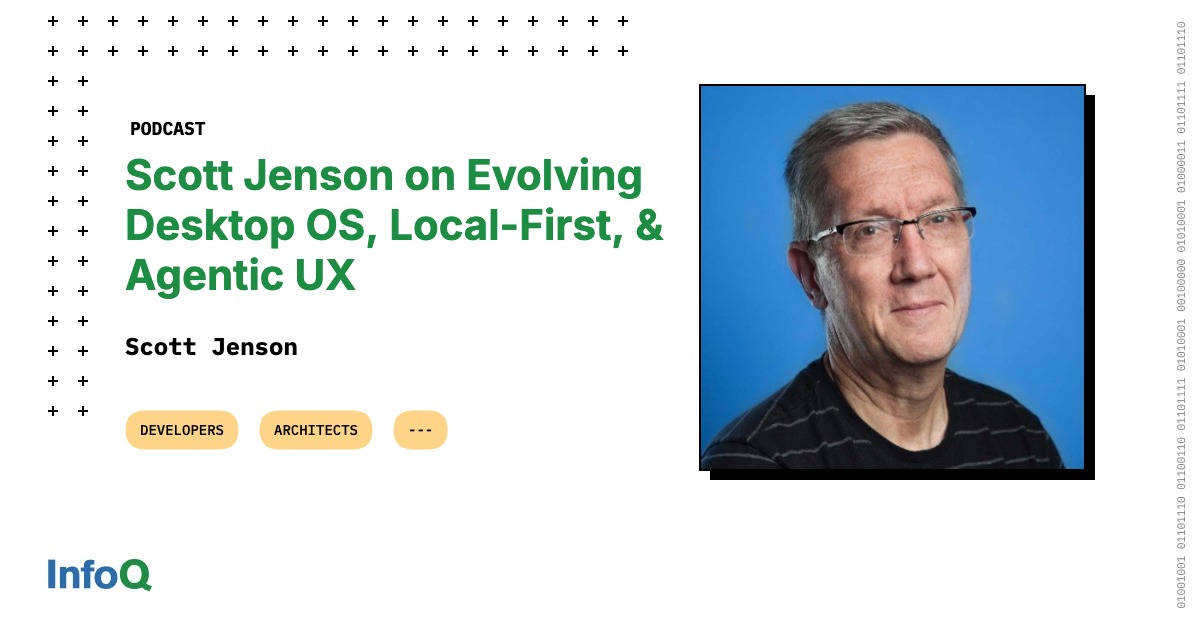
📖 Source: Podcast: Scott Jenson on Evolving Desktop OS, Local-First, & Agentic UX
Related Articles
Comments (0)
No comments yet. Be the first to comment!