
AI Dev Tools: Beyond Autocomplete to Multi-Agent Reliability

Alps Wang
Jul 9, 2026 · 1 views
The Agentic SDLC Evolution
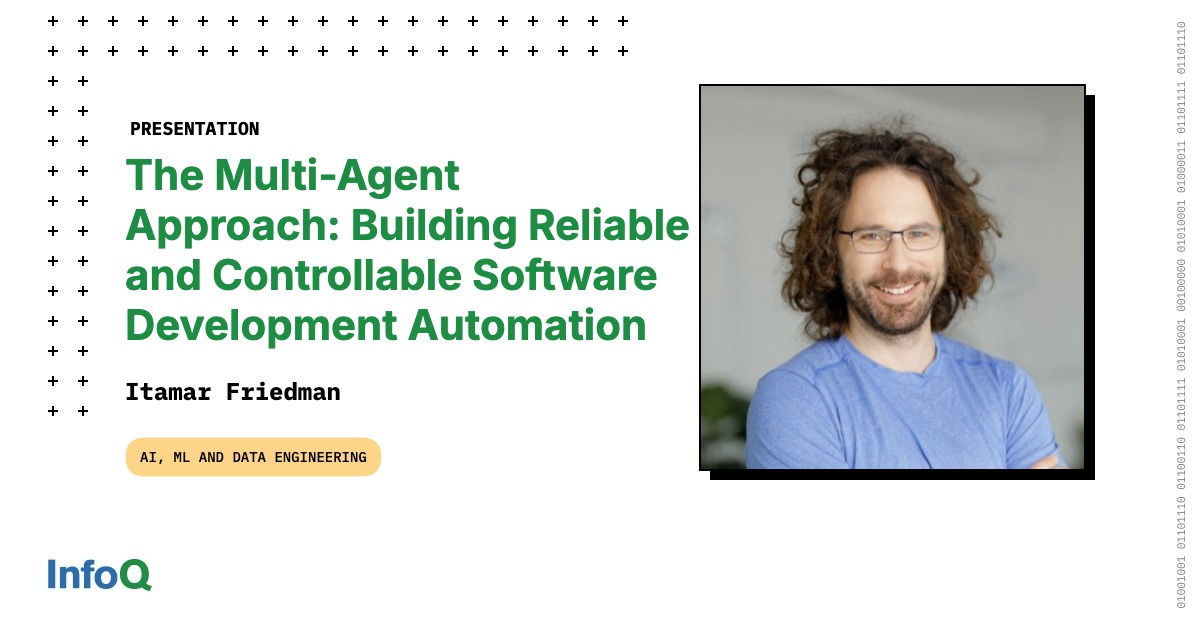
Itamar Friedman's presentation on the multi-agent approach for software development automation is highly relevant and timely, addressing the burgeoning adoption of AI dev tools and the critical need for reliability and control. The core insight is the shift from simple code generation to complex, interconnected agent systems that can manage the entire Software Development Life Cycle (SDLC). The motivation drawn from recent cloud outages and the high percentage of AI-influenced code highlights the urgency of this discussion. Friedman effectively illustrates the limitations of current tools, particularly the inconsistency of even well-defined prompts and the subsequent bottleneck shift towards testing and code review. The proposed solution, an adaptive, quality-grounded multi-agent system, is a logical progression, emphasizing the integration of autonomous testing, intelligent code review, and robust arbitration. The emphasis on continuous learning and context-driven workflows is particularly noteworthy as the path to breaking through the current 'glass ceiling' of AI productivity.
However, the presentation, while insightful, could benefit from more concrete, detailed examples of how these multi-agent systems are architected and implemented in production. While the Cursor example is illustrative, the 'testing agent' and 'code review agent' descriptions remain somewhat high-level. The mention of a Google paper claiming multi-agent systems are 'bullshit' is intriguing but requires deeper exploration of the counter-arguments and how the proposed Qodo approach navigates these criticisms. The reliance on LLMs, while central to current AI dev tools, also presents inherent challenges in terms of determinism, explainability, and potential for subtle errors, which the multi-agent approach aims to mitigate but doesn't entirely eliminate. The 'context engine' and 'arbitration' mechanisms are key components that warrant more technical depth to fully grasp their efficacy in ensuring reliability and control.
Key Points
- The increasing adoption of AI dev tools, with a significant portion of code being AI-generated or influenced.
- Current AI code generation tools, while boosting productivity in writing code, often shift bottlenecks to testing and code review due to quality concerns.
- The limitations of prompt engineering with LLMs, leading to inconsistent results even with detailed instructions.
- The proposed solution is a multi-agent system approach for building reliable and controllable software development automation.
- Key components of this approach include autonomous testing, intelligent code review, and robust arbitration mechanisms.
- The goal is to create an adaptive, context-driven SDLC that breaks through the 'glass ceiling' of AI productivity.
Related Articles
Comments (0)
No comments yet. Be the first to comment!