
AI Coding Assistants: Shifting Bottlenecks Upstream

Alps Wang
Mar 25, 2026 · 1 views
The Bottleneck Shift: From Code to Intent
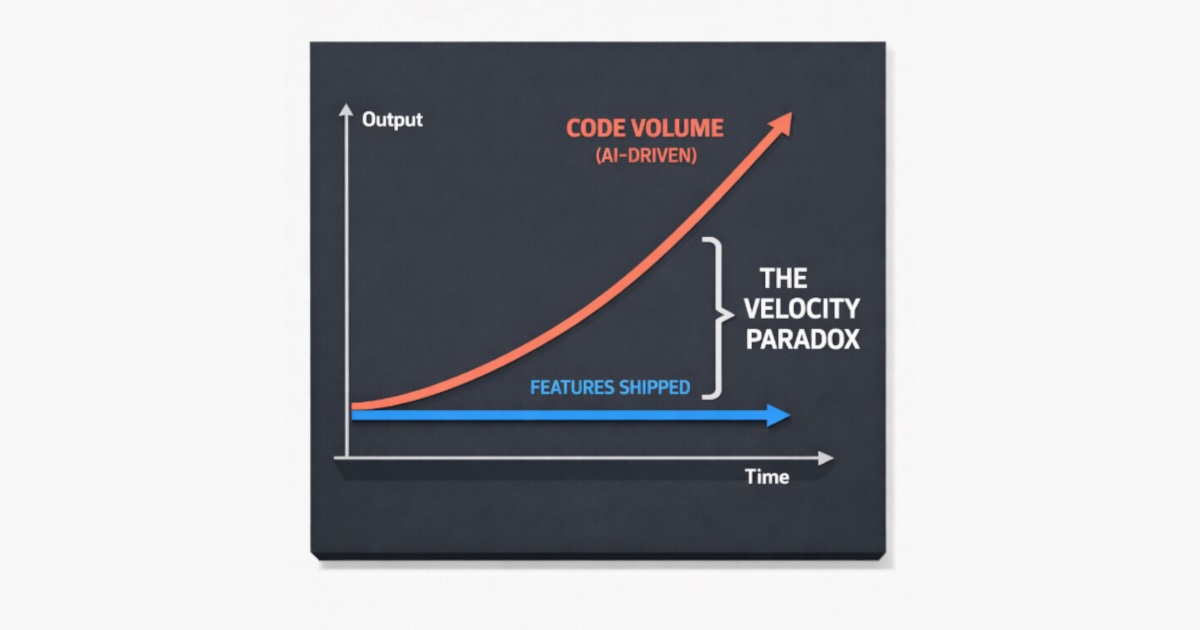
The core insight of this article—that AI coding assistants haven't dramatically increased overall delivery velocity because coding was never the true bottleneck—is a profound and timely observation. By shifting the bottleneck upstream to specification and verification, the article posits a fundamental change in engineering team structure and the nature of value creation. The 'grey box' model for human-AI interaction, emphasizing precise specification and evidence-based verification over line-by-line code inspection, is a pragmatic and forward-thinking approach. This reframing of human accountability to intent definition and governance, rather than direct code implementation, aligns with the evolving landscape of AI-augmented software development. The article effectively uses Agoda's experience and Faros AI's data to substantiate its claims, providing a strong empirical basis for its arguments. The connection drawn to Fred Brooks' 'No Silver Bullet' adds historical context and reinforces the principle of diminishing returns from optimizing a single phase of development.
However, a limitation could be the potential for oversimplification of the 'coding' bottleneck itself. While the article argues it wasn't the bottleneck, the sheer volume of code generated by AI might introduce new forms of complexity in debugging, integration, and understanding that are not fully captured by 'verification.' The 'grey box' approach, while sound, places a significant burden on the quality and precision of specifications. Crafting these high-fidelity specifications requires a deep understanding of system architecture, potential edge cases, and intended behavior, which itself is a highly skilled and time-consuming activity. The article hints at this by stating the engineer remains responsible, but the practical challenges of ensuring specifications are sufficiently robust for AI execution and for future maintenance and evolution warrant further exploration. The implication for team structure, moving from minimizing communication to embracing it as the core work, is a powerful argument, but the practical implementation of fostering this deep, shared understanding in larger or distributed teams remains a significant organizational challenge.
Key Points
- AI coding assistants have increased individual developer output but not overall project velocity because coding was not the primary bottleneck.
- The bottleneck has shifted upstream to specification and verification, areas requiring human judgment.
- This shift implies a reevaluation of engineering team structures, with communication and shared understanding becoming central to value creation.
- The 'grey box' model is proposed, where engineers focus on precise specification and evidence-based verification, not line-by-line code inspection.
- Human authority is migrating from writing code to defining and governing intent.
📖 Source: AI Coding Assistants Haven’t Sped up Delivery Because Coding Was Never the Bottleneck
Related Articles
Comments (0)
No comments yet. Be the first to comment!