
AI Agents: The Future of Dynamic Web UIs?

Alps Wang
Oct 19, 2026 · 1 views
Local AI: A New Paradigm
Rachel Lee Nabors's discussion on local-first web applications and the use of Small Language Models (SLMs) for on-device AI tasks is a timely and insightful exploration of a burgeoning technological frontier. The core argument—that SLMs can effectively replace cloud-hosted LLMs for many common tasks like summarization and moderation, thereby enhancing privacy, reducing latency, and cutting costs—is compelling and well-supported by her experience with the Mima project. The emphasis on systematic model evaluation using golden datasets and the concept of client-side moderation are particularly noteworthy, offering a practical approach to leveraging AI without the inherent risks of sending sensitive data to third-party servers. This perspective challenges the conventional wisdom of relying on large, centralized AI models and instead champions a decentralized, user-centric approach.
However, a key limitation or concern lies in the scalability and generalization of SLMs. While Nabors highlights their effectiveness for specific tasks, the article doesn't deeply delve into the trade-offs when AI agents need to perform more complex reasoning, creative generation, or integrate with a wider array of external services. The potential for significant performance degradation or the need for a constellation of specialized SLMs could become a bottleneck. Furthermore, while the 'local-first' approach is lauded for privacy, it introduces challenges for cross-device synchronization, data backup, and sophisticated collaborative features that often rely on cloud infrastructure. The article touches on the idea of OS-level agents and standardized UI schemas like A2UI, which hints at future solutions for these integration challenges, but the immediate practicalities for developers building current-generation applications remain a point for further exploration. The evolving skill set for engineers, moving towards CS fundamentals and AI collaboration, is a crucial takeaway, suggesting a significant paradigm shift in software development that will require substantial adaptation.
Key Points
- Local-first web applications offer privacy-focused, low-latency, and cost-effective alternatives to cloud-hosted LLM wrappers.
- Small Language Models (SLMs) running on-device can handle tasks like summarization and moderation effectively, avoiding high API costs and PII exposure.
- Systematic evaluation of models using golden datasets is crucial for right-sizing and selecting the best SLM for specific tasks.
- The rise of OS-level personal agents and standardized UI schemas (like A2UI) may redefine traditional web and native application interfaces.
- Software engineering skills are shifting towards computer science fundamentals, system design, and AI collaboration, moving beyond basic code generation.
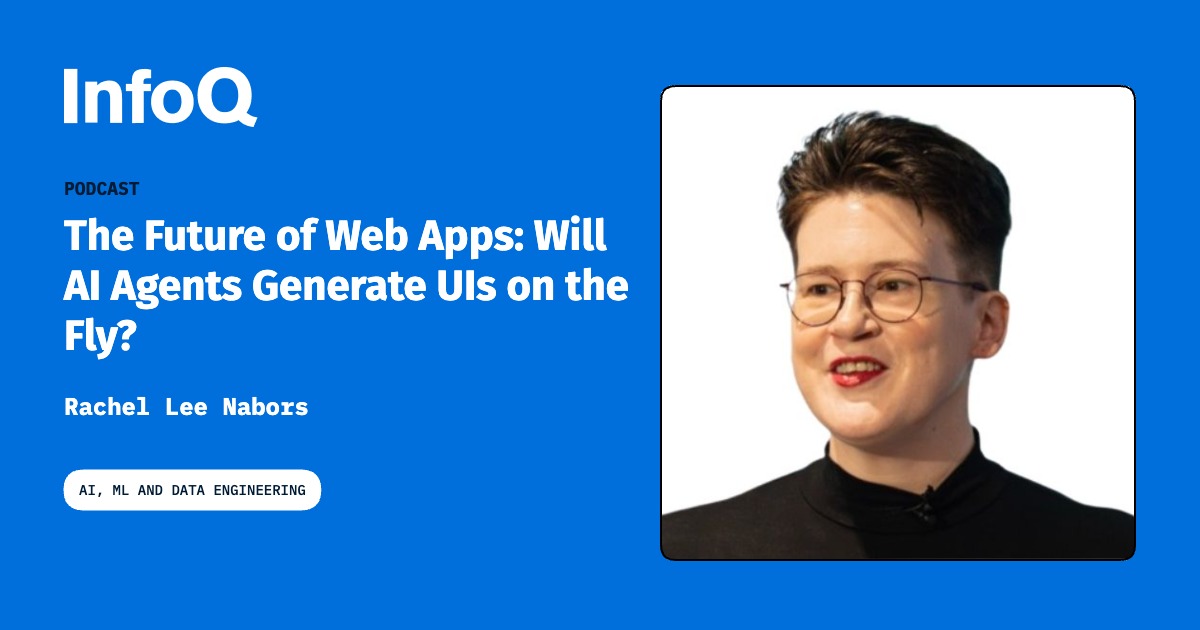
📖 Source: Podcast: The Future of Web Apps: Will AI Agents Generate UIs on the Fly?
Related Articles
Comments (0)
No comments yet. Be the first to comment!