
AI Agents: From Hype to Robust Foundations

Alps Wang
Jun 17, 2026 · 1 views
Engineering the Agentic Future
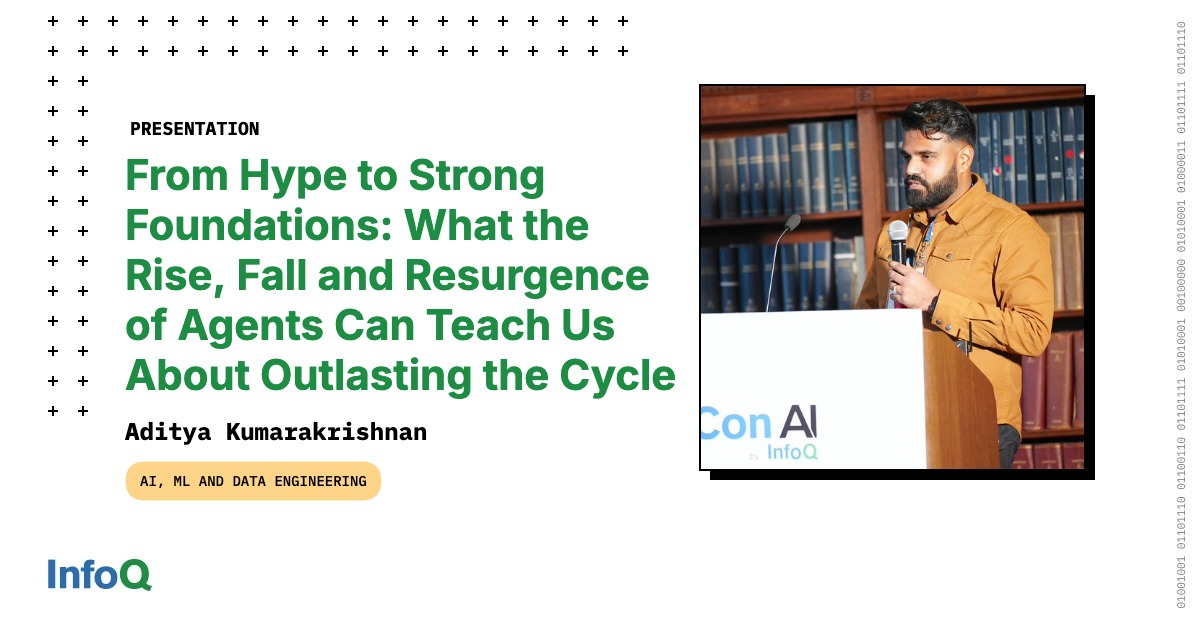
Aditya Kumarakrishnan's presentation provides a much-needed perspective on building durable AI agent systems by advocating for a return to foundational principles and modular design. The core argument for liberating the 'agent' concept from being solely tied to LLMs is particularly strong. This broader view allows for future-proofing and a more problem-driven approach, rather than being locked into specific implementation details of current LLM-based architectures. The emphasis on modularity, inspired by frameworks like CoALA, directly addresses the common pain point of 'throw-it-all-out' rewrites when new agentic paradigms emerge. By decomposing agents into well-defined subcomponents like memory (especially procedural memory) and a more tightly scoped LLM role, developers can create systems that are more adaptable and easier to evolve.
However, a potential limitation lies in the practical adoption of these principles. While the theoretical underpinnings are sound, the widespread 'amnesia phase' Kumarakrishnan describes suggests a significant gap between understanding these concepts and their implementation. The complexity of truly modular design and the effort required to "terraform" legacy environments into event-sourced, robust systems can be substantial. Furthermore, while CoALA is presented as a compelling abstraction, its maturity, community adoption, and ease of integration with existing toolchains are crucial factors for its widespread impact. The presentation could benefit from more concrete examples of how these modular principles translate into tangible benefits in complex, real-world scenarios beyond the theoretical. The reliance on concepts like 'process science' and 'event-sourced artifacts' also implies a need for a strong understanding of traditional software engineering best practices, which might be a steeper learning curve for teams solely focused on LLM prompt engineering.
Key Points
- The concept of AI agents is inevitable due to converging trends in computing (ubiquity, interconnection, human orientation, delegation, intelligence).
- We are currently in an "amnesia phase" of AI agent development, repeating past mistakes due to shaky foundations.
- Key to building lasting agent systems are four foundational ideas: embracing a stronger, more general notion of agents (liberated from LLMs), building modular and extensible agents, leveraging process science, and "terraforming" agent environments.
- Agents should be viewed as a general-purpose computing abstraction, not solely tied to LLM feedback loops, to ensure future-proofing and a problem-driven mindset.
- Modular agent architectures, like those inspired by CoALA, decompose agents into subcomponents (e.g., memory, LLM) to facilitate evolution and avoid costly rewrites.
Related Articles
Comments (0)
No comments yet. Be the first to comment!