
Agentic Systems: Production Engineering's Next Frontier

Alps Wang
Oct 2, 2026 · 1 views
Navigating the Agentic Production Landscape
The article effectively highlights the critical shift from AI agents as merely code-writing tools to active participants and users of production systems. The key insights revolve around the practical, engineering challenges this introduces: defining safe delegation of tasks to agents, establishing verification mechanisms for agent-generated work, designing systems to expose context securely, and identifying areas where human oversight remains indispensable. The sessions at QCon San Francisco 2026 promise concrete examples from leading companies like Airbnb and OpenAI, focusing on layered security approaches for customer-facing agents, the operating model for scaling products with coding agents, and the system-wide trade-offs involved in optimizing AI-driven systems at scale. The emphasis on 'making production legible to agents' is particularly noteworthy, suggesting a new paradigm in API design and system introspection.
The limitations, inherent in an article previewing a conference, are the lack of deep technical details which are expected to be covered in the actual sessions. The article focuses on the 'what' and 'why' rather than the intricate 'how.' While it touches on various aspects like input sanitization, classifiers, shadow testing, compression algorithms, and tool descriptions, the actual implementation nuances are left for the conference attendees. For organizations not yet at the scale or maturity of Airbnb or Netflix, some of the solutions might seem aspirational. However, the core principles are broadly applicable. The article correctly identifies that this is not about the future of AI, but the immediate engineering decisions required to integrate AI agents into production, making it highly relevant for senior engineers, architects, and engineering leaders.
Key Points
- AI agents are evolving from code generators to active users of production systems.
- Key engineering challenges include safe task delegation, verification of agent work, secure context exposure, and identifying human oversight needs.
- Airbnb's approach to guarding customer support agents involves layered security: input sanitization, classifiers, shadow testing, and rapid response.
- OpenAI's experience with coding agents highlights feedback loops, verification, token economics, and retaining human ownership for critical decisions.
- Optimizing AI systems at scale involves managing distributed system trade-offs like latency, capacity, and compatibility, as exemplified by Netflix's adaptive compression in key-value storage.
- Making production systems 'legible' to agents requires clear intent, context, and constraints via well-defined schemas, tool descriptions, and output formats.
- The conference offers practical insights for senior engineers and leaders on integrating AI agents into production workflows.
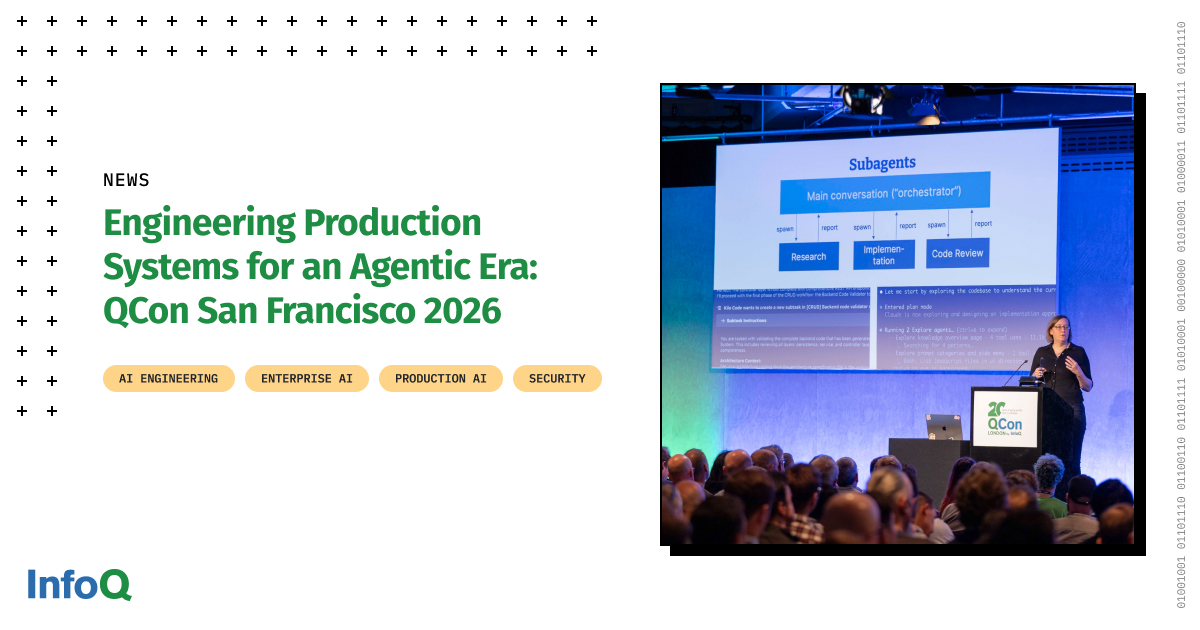
📖 Source: Engineering Production Systems for an Agentic Era: QCon San Francisco 2026
Related Articles
Comments (0)
No comments yet. Be the first to comment!