
Agentic AI on AWS: Faster Feedback, Smarter Code

Alps Wang
Mar 27, 2026 · 1 views
Unlocking Agentic AI's Potential
The AWS Architecture Blog article 'Architecting for agentic AI development on AWS' provides a timely and crucial framework for enabling AI agents to move beyond suggestion and into autonomous code creation, testing, and refinement. The core insight is that traditional cloud architectures, built for human-driven, infrequent deployments, create significant friction for AI agents requiring rapid feedback loops. By advocating for architectural patterns that prioritize local emulation, lightweight cloud testing, and clear code boundaries, AWS offers a practical roadmap for developers. The emphasis on domain-driven design, layered testing, and machine-readable documentation highlights a shift towards making codebases more interpretable and manageable for AI.
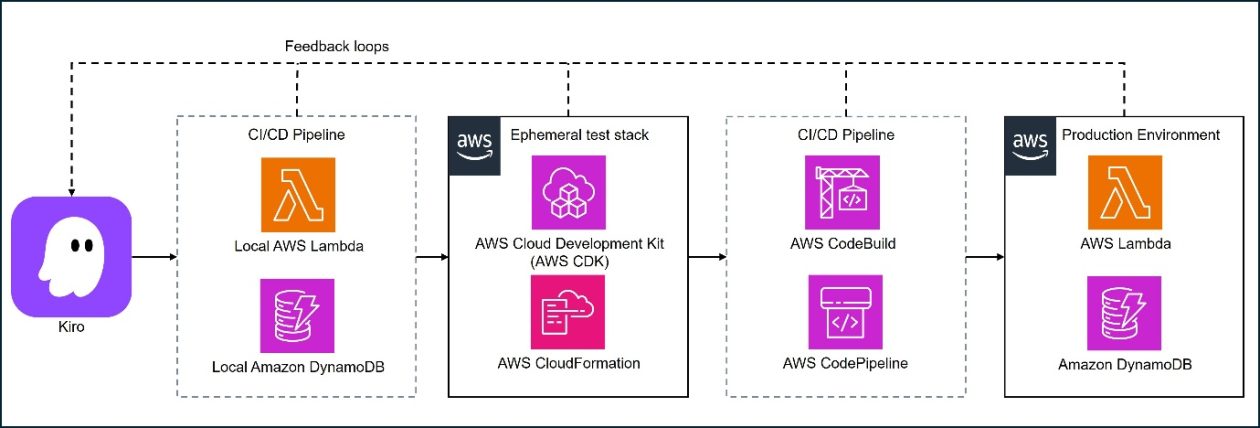
What's particularly noteworthy is the actionable advice provided, such as leveraging AWS SAM for local Lambda emulation, using DynamoDB Local for data persistence testing, and the concept of preview environments for end-to-end validation. The article correctly identifies that better prompts are insufficient; the underlying architecture must be redesigned. The proposed solutions directly address the latency and complexity that currently hinder AI agent autonomy. The integration of tools like Kiro, while specific, exemplifies the need for mechanisms that bridge human architectural intent with AI execution. This article is a valuable contribution for cloud architects and engineering leads looking to harness the full power of generative AI in their development pipelines.
However, a potential limitation is the implied complexity of refactoring existing, non-agentic-friendly architectures. While the article outlines the ideal state, the transition for established systems could be substantial. Furthermore, the article touches on security and governance with CI/CD guardrails, but a deeper dive into the security implications of autonomous AI code generation and deployment might be beneficial. The article assumes a certain level of developer maturity and familiarity with IaC and DDD principles, which might not be universal across all teams. Despite these points, the article effectively sets the stage for a new era of AI-augmented software development by focusing on the foundational architectural requirements.
Key Points
- Traditional cloud architectures create friction for AI agents due to slow feedback loops, tight coupling, and opaque codebases.
- Agentic development requires architectures that support fast validation, safe iteration, and clear intent.
- Key system architecture patterns include local emulation (AWS SAM, ECS/Fargate containers, DynamoDB Local), offline development for data workloads, hybrid testing with lightweight cloud resources, and preview environments with contract-first design.
- Codebase architecture should be domain-driven with explicit boundaries (e.g., /domain, /application, /infrastructure layers) and reinforced by project rules or steering files.
- Tests are crucial as executable specifications, with a layered strategy (unit, contract, smoke tests) providing fast, objective validation.
- Monorepos and machine-readable documentation enhance AI agent context and understanding.
- Integrating agents into CI/CD pipelines requires guardrails like automated reviews and branch protections, with gradual expansion of autonomy.
Related Articles
Comments (0)
No comments yet. Be the first to comment!